Forgive me.
I've been indulging in the tasteful lately.
I've been listening to -- and not getting enough of -- Simple Minds' Reel To Real Cacophany lately. "Citizen (Dance Of Youth)" and "Premonition" are two songs that I have been particularly taken by. And because of the fact that this album is one of those albums everyone pretty much agrees on in terms of critical acceptance, I don't really feel like I could add anything unique to the discussion. Except to say this -- it is stunning how exceptionally distinct this album is from the latter '80s-era Simple Minds releases, when they found themselves as close to the mainstream as they were ever going to be and with John Hughes knocking down their doors in search of a performance. I wonder if the band knew that that song, a song they didn't even write, would turn out to be their most memorable and popular song.
I've also been indulging in the not-so-tasteful, at least not according to the critical massive. Alphaville are one of the uniquely '80s artists whose music is not going to be in for a new and fresh critical reevaluation anytime soon, yet I find their anthemic music, soaring with hope and wonder, to be the perfect music for a post-cynical era that offers up few heroes and even fewer dreams. When the listener wraps his/her ears around such aural candy as Afternoons In Utopia and Forever Young, the swirling, soaring synthesizer sounds cause a swooning, soothing sensation in the listener's deepest cerebral recesses. (Sorry about the alliterative usage there.) It really feels as though one could be carried away on a wisp of wind after listening to one of Alphaville's gorgeous and lush productions, and it definitely strikes a blow against preconceived notions based upon origins when you take into consideration the band's German origins. They certainly don't sound Teutonic or aggressive. Their hyperromantic sensibilities appear to be more in tune with what people would expect from the Spanish! But these Berlin non-blondes prove that just because you come from a land traditionally associated with reserved manners and emotions doesn't necessarily mean you will exhibit that standoffishness yourself.
So I suppose all is right in the world. I vacillate between the credible and not-so credible, as always.
Showing posts with label editorial. Show all posts
Showing posts with label editorial. Show all posts
Tuesday, May 22, 2007

Monday, May 21, 2007
The Civil War Outside My Head: '90s Teens vs. Today's Teens and '80s Obsession
It is blowing my mind how many teenagers these days appear to have an honest adoration for the music and pop culture of the '80s. I have never seen so many individuals between the ages of 13 and 19 claim to be fans of such artists as Depeche Mode or Duran Duran. It is hardly the kind of thing I could have predicted even approximately seven years ago, back when we ushered in the 21st Century. And while I couldn't be more delighted that my beloved '80s is getting some positive attention from a generation younger than my own, at the same time it feels disorientating, throwing me into a confused eddy of conflicting thoughts and emotions.
First off, why is this happening? I suppose part of it could be the influence of '80s pop music upon the present musical landscape. When such mainstream pop acts as Gwen Stefani and Justin Timberlake and credible indie acts such as The Killers and Franz Ferdinand can both proclaim heavy and devoted influence by some of the preeminent pop music artists of the '80s, I suppose that would turn the young people's attentions to that long-unexplored genre. I suppose I should also look at the increasing distance time-wise between the '80s and today. Much like how the youth of my generation embraced patently '70s artists such as Neil Young and christened them once more with the "cool" label, the time would be right at the present moment to openly and unreservedly embrace the artists who defined the '80s. Moreover, teenaged adolescence is supposed to be about being rebellious, and what could be more rebellious in the wake of the flannel-clad '90s than to bask in the warm glow of the '80s' fine tailoring?
So I suppose I can "get it" on a logical basis. Still, I can't help but think: Why now? Why are these young people being afforded the opportunity to be able to interact with like-minded individuals in their own age range when I was having incredible difficulties doing the same just ten years ago? I know, I know. This is the green-eyed monster in me talking. I should not let myself be caught up in jealousy but rather celebrate the fact that these younger people will be able and willing to carry the '80s-loving torch for the scattered few '80s adorers in my generation/age range. However, I would have loved for there to be more people my own age who loved this pop cultural decade/era in the same manner and under similar circumstances that I did.
Back when YouTube was still working (i.e. before Viacom became complete and utter assholes), I would gaze at the lengthy and impressive list of retro '80s music videos resident on the site and would be immediately awed. Here were the fabled videos I had only just heard about! I spent many a stolen moment running over to YouTube to view as many of those classic music videos as time would allow. But at the same time I would notice that a lot of the individuals commenting favorably about many of those videos were individuals who were in their teens, and that's when it dawned on me how much easier this new generation of '80s retro fans had it. They had YouTube at their disposal to view any/all '80s videos and commercials and other video tidbits. They could congregate together on groups on MySpace and Yahoo! and discuss the aspects of '80s fandom they particularly enjoyed. They could order up virutally any vinyl record, download virtually any mp3, listen to a rich and impressive mixture of '80s retro radio stations online, Google all manner of '80s pop culture accoutrements. For this new generation of '80s fetishists, the '80s is so much more available than it could have ever been for the average teenaged '80s fanatic in my age group.
However, I don't want to discourage that kind of '80s adoration from or by anyone. I don't want to devolve into wanting to foment any sort of intertribal conflict amongst the '80s favoring massive. Heaven knows the challenges we still have yet to face, particularly amongst the clueless and out-of-touch mainstream that still believes that that which is patently '80s are still ripe for ridicule. While fashion choices are appearing to be increasingly influenced by the prototypical fashions of the '80s, one would still be hard-pressed to find the fluffy-sweatered, frilly-bloused aspects of '80s fashions that it appears that real '80s teenaged girls donned. While '80s movies directed at teen audiences have always been readily available on DVD and at least one contemporary movie, Not Another Teenage Movie, paid earnest homage to that filmic genre, there is really nothing that compares to the experience of actually viewing a movie on the big screen. And Viacom's pig-headed actions both online and on the air provide evidence that The Corporation That The Eighties Built is still uncomfortable with actually acknowledging that history and giving others the opportunity to discover or remember it.
You know, I think my problem is that I feel like I'm stuck with Middle Child Syndrome here. Stuck in the middle between the generation that embraced the '80s as a contemporary part of their own teenaged adolesences and the generation that is embracing the '80s as a now-relevant, newly important reference point for contemporary pop culture, I differ from both in that I came into that adoration while said adoration was considered passe. Finding individuals in their mid - late 20s who could honestly tell you they favored the '80s above all other pop cultural decades will be a monumental task. Yet I logically realize that I am to be an exemplar figure for this new generation of '80s lovers, someone from whom inspiration, advice, and lessons only experience can give will be derived. Yet I am a part of the unwritten story that I alone can write, the unspoken history that I alone can tell, and because of that I suppose I should begin to really tell it, on an honest and noncontrived manner that will allow for that window to finally be opened. It is my full intent, now that I have the time to do so, to honor that promise.
Sunday, May 20, 2007
The Civil War Inside My Head: '80s vs. '90s
I wonder how long ago my last blog entry herein was. It feels an age ago, though I'm sure it was at most a week. Apologies. I will make up for it.
So I've been doing a lot of confused running around in terms of the pop culture that I'm exposing myself to. I recently purchased a secondhand item that reminded me poignantly of the '90s adolescence I was exposed to and have noticed little elements of this '90s frame of reference popping up here and there ever since. Whether it be a '90s song snuck into a block of purportedly '80s R&B songs or a once-faded memory of a '90s experience I actually enjoyed, it appears as though the '90s are calling me back, haunting me to this very day.
I don't know if I should be mentioning this in an '80s-centered blog, especially since I have stated very clearly that I found the reality I faced in a '90s existence miserable comparative to the fantasies I had worked up of The Eighties. But it is, unfortunately, true. I have been unwittingly shaped and defined by my '90s "childhood" (insofar as those trite '80s nostalgia lists have been about the "childhood" such lists claim) as much as, if not more than, the '80s pop culture I chose to wrap myself around. I cannot help but look at something such as gangsta rap and remember that I Was There in a much younger guise when it emerged into the general American mainstream consciousness. 15 years later and I can instantly recall the "I didn't even have to use my AK/Today, it was a good day" line, even though I was at the same time cultivating an adoration of Talk Talk's The Party's Over and had crushes on Tony Hadley and Bryan Ferry bubbling underneath. Still, gangsta rap, grunge, sample-driven Eurodance, and R&B were a part of my everyday landscape, and they are a part of who I am, like it or not.
It's funny, you know. The '90s were the era that was forced onto me. I think I've stated here before how I cried myself nearly to sleep every night because I did not want to be a part of the '90s. The '80s appeared from the glimmery, distanced vantage point I had to be by far the better decade. I would stare at my oversized black t-shirt and baggy jeans and daydream about wearing an outfit that a Molly Ringwald character in a John Hughes movie would wear, or an oufit that the title character in Valley Girl would approve of. I dreamt vivid fantasies of walking down the corridors of a suburban Chicago high school, wearing frills and fluff, carrying my textbooks and gabbing along with several of my closest friends about John Taylor or the latest Billy Idol album. Then we would all hang out after school at each other's houses, styling each other's hair and snacking on pizza rolls and TaB while watching music videos on MTV and turning the volume up when Howard Jones's "New Song" or "Doctor! Doctor!" by the Thompson Twins came on. Then my alarm clock would wake me up and I would awaken to the reality of life in an inner city Catholic high school, having to rely on shitty VH1 retro '80s programs for my music video fix, and the fact that (a.) I was thousands of miles and over ten years away from that fantastical suburban Chicago dream world and (b.) the MTV idols of the era were more likely to be Dan Cortese or one of Boyz II Men.
Yet the '90s affected me. Had it not been for the distancing effect of the '90s, I might have just as easily discounted the '80s. The reality is that the '80s wasn't all just about delightfully poppy New Wave synth music. The '80s also encompassed John Cougar Mellencamp, David Lee Roth, Bruce Springsteen, Bon Jovi, and other crimes against music. And I wasn't too young to be aware of the '80s from ca. 1983 onward. From my recollections of those years, I remember the threat of nuclear annihilation hanging over everyone, and the Soviet Union still looming large in the landscape as a threatening figure. Also, there were new bogeymen just peeking from over the horizon as global terrorism began to hit home. Who can but forget the horrific events of Pan Am Flight 103, exploded over Lockerbie, Scotland by the Libyan terrorists who hijacked the plane and used it for their own nefarious purposes over a decade and a half after the unforgettable events of September 11th? To those of us who were barely young enough to be conscious/cognizant of world or national events, the '80s were a time of constant revolutions, fighting, and bloodshed. How much richer, then, must the pop culture have been in order for the teenagers of that era to go on living life as carefree as previous generations of teenagers had! It is because the '90s were comparatively stable and peaceful that we as a society ended up with anemic and unfulfilling pop culture during that time period. Because circumstances did not demand for particularly entertaining entertainment, the '90s became the perfect incubator for "Friends", the Counting Crows, and a culture where sipping coffee in a coffee house, wearing slovenly attire and listening intently to sober-minded "political" poetry was considered the "in" thing to do.
I can still find glimmers of hope, though, even in the '90s. I can see why I gravitated toward Nirvana, even without the "Kurt Cobain as teen idol" factor; their music, as heavy and loud as it was, brings to mind the band's overt and much-stated power pop influences. There are some Nirvana songs that sound eerily like Cheap Trick outtakes. The popular dance song "Something Good" by Utah Saints introduced many in my generation, including myself, to the luminous vocals of the '80s alternapop queen Kate Bush, who was to the underground college radio scene what Madonna was to the mainstream. Listening to late '80s college radio fodder, one can instantly find cues that such "Alternative Nation" darlings as the Catherine Wheel picked up. And, of course, while rap was invented in the '70s, it was the '80s that took it out of the streets and put it on the airwaves.
However, I cannot stop sensing that I just did not belong in the '90s. Take, for example, "The Real World". Granted, I was addicted to the first four seasons of this show, and I once had thought about what I'd do should I end up being on that program. But the people showcased on that program were by and large people of the era. Even though the first two seasons were populated by the same former '80s teens I envied/wanted to emulate, by the time they were at the stage in their lives that they were in during their participation in "The Real World", they were also fully of the present era. Even the older participants in the first season, Norm and Kevin, belonged more to the '90s than I felt/feel I ever could or would. And in a sense I envied that, too, because I did not want to be an Other. As with every other adolescent out there, I did not want to have any aspect of myself be "different", so the fact that those and the rest of the roommates I observed during that time period were able to blend in and be of the decade I at once both hated and desperately wanted to be a part of was -- well, it was disorientating, to say the least. Yet I continued to watch, only giving up the ghost when the London season ended and I began my gradual disattachment from MTV.
Even still, I am aware that perhaps I am blessed to have discovered the '80s in the manner that I did. Maybe I would have been just as disillusioned about that decade as I was/am about the '90s. Perhaps the '80s would have left me just as much in a sea of confusion and disappointment had I experienced it as it happened, at the age I've felt for a long time I should have been. Though I still can't help wishing and hoping and praying for the opportunity to experience it firsthand, to at least get a taste of that which I have pined for, for so long.
Monday, May 14, 2007
Slaying A "Guilty Pleasure"-Labeled Dragon
Apparently I do have time for a tiny morsel of profundity.
My adult life has, admittedly, become quite a complex maze of activity and actions, of first impressions that are needed to be made in a positive manner and of impressions made upon individuals who are of the utmost importance to the innermost self. This confused jungle of thoughts and ideas and processes sometimes overwhelms me, makes me lose contact with who I am at the very core of my being. So whenever those times come, I usually tend to find myself lost in music for a spell, searching for a remedy and re-validation from the tunes that I have adored for a very long time. Some of these songs are perfectly okay to mention in decent music-listening and -obsessed company. These songs evoke a sense of the listener, i.e. me, having taste and class in her musical selections. Then there are what would be known as "guilty pleasures".
Admittedly, I find myself reaching more and more for what might be considered a "guilty pleasure" whenever times get their toughest. I suppose it's because those songs, without the requisite credibility factor inherent in songs discovered later on in my music listening life, reach to the very deepest parts of me, where the parts of me that have been living and beating inside me for over a decade resides. Tonight I felt the intense need to reach for one of those songs, a song I remember very well from my early adolescence.
It was Laura Branigan's "Self Control".
Now, this song isn't to be considered "New Wave" or "synthpop" in any real sense of the terminologies. This was just a very hi-nrg, synthy, rock-flavored pop song, performed by a pop songstress for whom not even death has provided credibility toward. It is still (fortunately or unfortunately, depending on your own point of view) considered gauche to admit to liking a Laura Branigan song. Branigan's voice, as a critic I hate to admit was correct every once in awhile said, is safe. It's anonymous. Yet I sense in it a sort of gusto, a real conviction to believe what she sang, and in this era of "American Idol" oversaturation, where the predominant female pop singers are miniature divas with no real comprehension of what they are actually signing, there is something about how honest Branigan's singing is that breathes renewed hope within me for the power of really surprisingly good pop vocalization. (In fact, there are elements of her singing that remind me of Meat Loaf's, another singer with not quite the credibility factor of most yet with a small contingent of defenders.)
Which brings me to "Self Control". Unlike her previous smash hit "Gloria", Branigan (or her songwriters -- I'm not clear) decided to incorporate elements of the then-current musical zeitgeist, i.e. New Wave, into the song. There is the Linn drumming. There is the heavy synth action. There are the touches of robust guitar action. There is a staccato rhythm evident that showcases a sort of Italo disco flavor to the song, Italo disco being in and of itself directly influenced by New Wave. The atmospherics are cold sophistication. It is almost credible enough to be New Wave! But because it is Laura Branigan, and because it is more authentically pop, it resides in the mainstream pop universe. Because of that, syndicated '80s retrospective radio programs that aired throughout the mid - late '90s, with their emphasis on the straight-ahead pop of the decade, played "Self Control" on a regular basis. It was almost guaranteed, for instance, that Al Bandiero, late of the (now defunct) '80s radio program "The Amazing '80s" (which I listened to loyally in high school), would end up playing that song, and, truth be told, I did get tired of it after awhile.
Funny thing about those sorts of things. Flash forward over a decade later and now I sit here in front of the computer monitor, typing away at this entry while I listen to Laura Branigan's "Self Control" on repeat, breathing in the song, absorbing it, letting it become a part of me. I can feel it heal the confusion and heartache resident inside me. I can feel it working on all the little self-doubts and inferiorities inside me as it returns me to the more self-assured individual I now understand I was back when I was 16 and thought I knew everything about how the world works. But most importantly, this song washes away any aspect of inauthenticity about me. By constantly being exposed to this song and reawakening the excitement that I used to connect with it, I can no longer hide the person I really am, the person to be revealed after peeling away the layers of pretension and pretend coolness. Inside of me lurks a girl who has spent her whole life not being cool enough to hang with the cool kids, a geeky, awkward kid who spent the majority of her spare time with her nose stuck in a book, and even though I've gotten LASIK done, gotten rid of the glasses, sport stylish hairdos and clothing, and breeze about through real life as though I have infinite stores of confidence, I am still that tall-for-her-age, bespectacled nerd type who studied too much and spent too little time concerned with the popular crowd to actually be "popular".
I will always be that weird teenaged girl who adored '80s things and acted like she was 30, so she was to be looked at with suspicion. Songs such as "Self Control", which were so much a part of those years for me, remind me of that. And as odd as it might sound, those reminders build my confidence as I reconnect with that same young girl, living now under layers and layers of "self" I have built up over the years in various attempts to try to fight against that kind of legacy. As a Real Adult, with all the Real Confidence that I've been unknowingly earning through the processes that greet any Real Adults, I can now say to that girl to keep her chin up, that things will get better, and that the things that make her "odd" will eventually be considered assets. So Laura Branigan, "guilty pleasure" figure? Not in this instance. In fact, it is the self-consciously "cool" that is to be considered a "guilty pleasure" here, as the authentic takes over and reawakens the parts of me that had been rendered unconscious due to inattention.
Wednesday, May 9, 2007
Duran Duran: The Saga Concludes. Part Four.
Ever since I've been online, I've been looking for a reasoned argument in favor of my favorite musical artist. Having spent ten years with no fitting solutions to that riddle, I've taken it upon myself to posit said argument. This is the conclusion of my Statement Of Fan Being.
In Britain, Duran Duran's debut album was received (generally) favorably, but as is the case with most musical artists that gain enormous amounts of popularity, the British music press turned on them by the time Rio was released. However, the American music media establishment has never been fair to Duran Duran. Not even Rolling Stone magazine, which put the band on its cover in January 1984, dared to go any further than a barely tolerant "we'll acknowledge you because you are a part of the zeitgeist, no more" attitude. By 1980, all corners of American pop cultural media were being controlled by the "peace and love" hippie children of the late '60s, individuals who were brought up to have very rigid ideas about who or what to respect in the worlds of entertainment. Detached guitar strumming and caterwauling about current affairs in some oblique manner was considered to be the acme of musical achievement. Dancing was out unless it was sloppy and accidental, mimicking some kind of drugged-out shimmy, and musical artists who showcased any sort of clean-cut, tailored style were definitely not taken seriously.
So when Duran Duran and their contemporaries came onto the scene and started attracting the attention of America's youth, these establishment figures sneered at their style and polish. It wasn't gritty enough, rock & roll enough, or masculine enough; its sound didn't properly rip off old and impoverished Missisippi bluesmen, and the lyrics? Well, geez, you actually had to ponder the meaning of the lyrics! Things weren't automatically spelled out for you! They were, dare I say it, less like a newspaper report and more like Shakespeare! The artists were advocating -- shock horror -- that the answer to living through an era when life was changing at a dizzying pace and mini-revolutions were happening on a near-daily basis was not to whine about things but rather to take charge, to revolt! Duran Duran came from a dark, dreary industrial city in an area commonly known as the "Black Country". Most of the band spent years doing manual labor while waiting for their big break. While touring the U.K. in 1980 in support of punk diva Hazel O'Connor, a tour that they hoped would attract the attention of record labels, the band lived out of their touring van, had a ten pound a day allowance, washed up at rest stops, and wore pretty much the same clothing throughout the tour. But they turned the charm and glamour on when they took to the stage, which led to a bidding war between at least two major labels, and remained true to themselves and their ethos even when they were at the height of their commercial success.
What Duran Duran and similar artists provided during those days was music both of and transcending from their time. They were quick to acknowledge the depressing state of affairs in Britain. They knew full well their country was entrenched in an economic recession. They were completely aware of the Falklands conflict. The threat of nuclear annhiliation hung over them all like a hauntingly great scepter. But instead of reacting with the naive expectation that one could solve those global issues through the Power Of Music, Duran Duran decided that the perfect solution would be to insist on having a good time in the face of all that adversity. It was a patently punk attitude; its rebelliousness tapped into the consciousness of young people who lived every day fearing a nuclear strike and saw news reports of this new threat of global terrorism, who tired of unsophisticated idealism and insisted that their music be entertaining. These young people weren't nearly as homophobic as the Establishment were and so embraced danceable music more readily, though there still existed a contingency of young, confused males who attacked homosexuality in a fevered attempt to deflect their own conflicted ideas about sexuality. (These were often also the same young males who embraced hair metal in the mid '80s.) Duran Duran has always provided its listeners with a true alternative to traditionalist ideas about How Music Must Be, which has confounded American arbiters of musical taste for decades.
Sadly, this means that Duran Duran has not yet been able to receive the accolades or respect due it by those individuals. One clearly apparent case involves two paperback books published about the band in 1983, toward the beginning of the peak in their popularity. One of these books was authored by a magazine journalist named Toby Goldstein and is an inconsequential volume riddled with errors. The other book was written by a fan named Cynthia C. Kent and, despite its occasionally basic prose (the author was still in high school at the time she penned this book), is perhaps one of the finest published works about the band to date. Kent argued passionately the cause for taking Duran Duran seriously and that calling has been passed down by generations of fans and other individuals outside of the music press establishment. For as long as there has been an Internet, there have been websites that have treated Duran Duran seriously (e.g. Tom McClintock's discography site and Eric Seven's Room 7609 website), zines that have filled the void in terms of adequate coverage of the band (one favorite was when Greg Bueno's Soloist's Notebook published a volume about the band), and mailing lists that were once abuzz with the kind of approbation the band never quite got. Flash forward a decade later and you have yours truly typing out these four essays, still attempting to make up for what the Serious Music People of the world have apparently yet to accomplish, i.e. a full and fair look at Duran Duran.
Complicating matters for Duran Duran is the astronomical success (both critical and commercial) of another group that emerged at about the same time and under similar circumstances, U2. U2 were easy for the members of the music press establishment to embrace. Their lyrics were overtly about social awareness, the music featured the same lead guitar-bass-drums lineup that rock music groups have been working with for many decades, the band's leader said all the right things about all the right social injustices, and all of that combined together to remind the original hippies of their Woodstock youth and reaffirmed their narrow-minded approaches to popular music. These people saw U2 as the very antithesis of what Duran Duran and their stylish associates were and pitted one against the other. Everything that U2 was, they figured Duran Duran wasn't. Bono spoke openly about global issues, which counted; Duran Duran's social justice involvement was more muted and Simon Le Bon spoke of the band being five individual members with distinct mentalities in defense of their non-outspokenness, which automatically branded the band with the incorrect status of not really caring about the state of the world. U2 were patently rock in a Rolling Stones style, which suited the machismo swagger of the Music Press Gatekeepers just fine; Duran Duran were more androgynously pop a la the early Beatles, which these same subtly homophobic editors and publishers just could not take. Bono is hailed as a savior and a saint when he does little to nothing on his own, but Simon Le Bon and other members of Duran Duran give constantly and generously out of their own pockets and little to nothing is said. Not even Le Bon's passionate and authentic devotion to Amnesty International is well known. The music press chooses to dwell on Simon's one singular moment of folly back in 1985 but all is forgotten regarding U2's major faux pas some ten-plus years later. Back when Duran Duran were at their most commercially popular in 1984, the common assertion was that their biggest rivals were London's Spandau Ballet (comprised as they were of males who grew up working class, who attached to themselves the same "we'll show the world by being glamourous in the face of adversity" attitude as their Birmingham contemporaries). The reality was, is, and always will be that Duran Duran's biggest and most damaging opposition stands with the four safely non-androgynous Irish males in U2, and it is because of the American Baby Boomers' sheer size in numbers that U2 have been able to almost completely erase Duran Duran's potent influence from pop music history.
Another reason people disparage Duran Duran is because the band were commonly known for having broken through with the assistance of MTV. What people don't realize is that the band were recording music videos for the adult nightclub market before MTV debuted in the U.S., that the only reason they capitalized on the advent of music video television is because they could not break America any other way, and that had they been able to break through via radio they would have. The only American DJ who gave Duran Duran a break was the legendary Rodney Bingenheimer of L.A.'s KROQ. No other Stateside DJ or radio station would give the band a chance, because their music did not fit the rigid guidelines set in place by radio station programming managers and owners. MTV was virtually the only outlet the band had for introducing their music to the masses, so they had to focus just as much care and attention in creating innovative music videos as they were already doing with their music, which only served to stoke the flames of those people who were driven to hate the band. Cries of "Oh, but they're a VIDEO band, don't you know?" were uttered by the very same people who caused the band to have no other choice but to utilize a visual medium to grab the attention of potential listeners or fans, something the band were not terribly thrilled about but nonetheless went with, because they believed in their music that much.
So in closing, I feel very strongly that the time came for everyone to view Duran Duran with new eyes a long, long time ago. Duran Duran, after all, are the reason why I am so enamored with so many musical artists that have not had a problem with gaining critical acceptance. I have been reassured time and again by people that my music tastes are superb; well, I wouldn't have the musical tastes I have without Duran Duran. Without Duran Duran there would have been no Josef K in my life, no Comsat Angels or The Cure or the Velvet Underground (Duran Duran inspired me to become a bigger fan of Andy Warhol, which then led me to the Velvets). Without Duran Duran, I would not have even become even remotely as interested in music as I am today. I would have simply continued to go along with whatever my parents' musical tastes were, eventually giving up the ghost in favor of -- well, nothingness, really. I've seen that kind of person, the person unaffected by music, and they have no spark of a spirit inside themselves. Their eyes are dull and dispassionate and their manner is nondescript. A real committment and passion to music makes a person all that much livelier and joyful, especially since music is omnipresent. Without Duran Duran to usher me in to a world where I could fully and passionately appreciate popular music, I would be another walking zombie. Thanks to them, however, I have that joie de vivre that has helped me out through so many incidents in my life where I could have simply chosen death -- of the self or of the soul -- instead of life. I'm glad I've chosen life. I'm glad I'm still a Duran Duran fan.
Tuesday, May 8, 2007
Duran Duran: The Saga Continues Again. Part Three.
Back for part three in an apparent four-part series revolving thoughts I've had about Duran Duran for a very, very long time, but have only just now consolidated to this one blog.
Duran Duran's music has been incredibly influential in terms of my music tastes post-1991, as I touched on in the last sentence of the last entry I made to this blog. What I didn't explain was the magnitude of this influence, which I still feel is an active one even in the present day. See, what Duran Duran did, as I stated before, was provide me with everything I was looking for in terms of music. They had the rhythm, they had the melodies, they had EVERYTHING. So when I became a more serious and thorough fan of their music, I began to fall for all the individual elements that comprised their music. I was attracted to the punk DIY influence peeking throughout nearly their entire career oeuvre, I loved the throbbing bass rhythm and beat, I felt thrills connected to the band's unconventional but prodigious use of synths in their New Wave rock style, and I loved the polished sophistication oozing from their pores, particularly after the band reunited post-Arcadia and Power Station.
So I began to seek out those very elements in whatever I was listening to. I found it easily with Duran Duran's most commonly associated contemporaries such as Spandau Ballet and Japan, sure, but I also found it easily with many artists not commonly connected to the band. Groups such as Gang Of Four and Wire provided for me many of the same elements I found myself enamored with via Duran Duran's music. GO4's music in particular was relatable in that they too were spawned from the revolutionary punk movement that rewrote the rules on rock music, but also contained within its music pulsating, shuddering rhythms that shook you to the core. And while GO4 didn't make use of synths until their wrongfully maligned 1983 album Hard, they always performed guitar lines that approximated that cold, synthetic sound that I so adored. As far as sophistication goes -- no one can argue that they had it in spades.
Even those musical artists I adore that could not be so easily relatable to Duran Duran's music, such as Joy Division, were brought into my life directly as a result of my Duran Duran fan adoration. Since I became a fan of Duran Duran's in the early '90s, when the only radio stations playing their music were college radio stations (who were staffed at the time with DJs who grew up with that kind of music), and since my fandom provided a need in me to pursue Duran Duran wherever they were, listening to college radio to hear Duran Duran's music played over the airwaves provided me with a direct exposure to all manner of musical artists I would have not ordinarily been exposed to had I just listened to contemporary music. MTV's retro program "Classic MTV" exposed me to more musical artists (e.g. The Church), and pursuing those rarer classic MTV clips on programs such as "120 Minutes" (during those rare occasions when I was allowed to stay up that late on Sunday night) gave me all the contemporary musical education I needed to at least give the illusion of being of the moment.
Those musical artists I now consider myself a fan of whom I didn't discover directly because of Duran Duran were uncovered for me via those other, more directly linkable artists, and going online in part to more actively participate in the fandoms ushered in pre-1997 has exposed me to even more. For example, because of my love for so many musical artists who emerged from the bosoms of the 1980s I became aware of the fact that I was a fan of a certain musical genre called "New Wave". Because of that fact, when I first went online, I searched for any and all New Wave-related resources available therein. Five years later, I discovered this exciting new resource called the New Wave Outpost, which provided me the additional service of giving me the chance to discover musical artists lost to the annals of time. As a direct result of this, I can now count several "obscure" musical artists amongst the list of artists in my fandom, and it has solidified my adoration of the whole of the New Wave musical genre set. (nb: This is coming from an Americentric point of view, so in other countries this would encompass a wide spectrum of genres. Example: One can accurately count post-punk, synthpop, and New Pop as elements of the American definition of New Wave.)
So now the question remains: Why, after all this time and all the many additional musical artists I've discovered to be just as thrilling for me to listen to, have I still maintained as much of a passion for Duran Duran as I have? I suspect part of it is because of the simple fact that They Were There First. They were my first exposure to this whole family of genres that I would later come to love and embrace. But there's also the simple fact that Duran Duran's music provides for me the proof that sometimes you CAN "come home again".
Witness my mentioning of "Hold Me" in the last entry, for example. I played it yesterday for the first time in months and it instantly triggered in me the same reaction it has induced in me since the moment I first heard the song, back in 1992. I felt the warm synths wash over me as the intense bass and urgent drumming pulsated their way into my innermost being, and when Simon Le Bon sang in a sweetly lullabying yet passionate way, I became just as sold on that song as the day I unwrapped my Notorious cassette and played it on my Walkman. And when That Guitar Solo began, I felt the sort of high that many people must seek out by trying drugs. "Hold Me" reaffirmed for me the real reason why I've never wanted to experiment with illicit substances; it's not that I have infinite stores of moderation and reserve, nor do I fear the police sufficiently enough, it's just that for me, music IS my drug, and Duran Duran has provided me with so many highs throughout my life that even when they make egregious errors in career judgement (e.g. by agreeing to work with Justin Timberlake), I will never stray from being one of their most outspoken advocates.
In fact, Duran Duran's music has touched my life so much, one can chart virtually half my life via their music. I have memories of going to the original, now-demolished Earl Abel's with my dad to pick up a family fried chicken dinner and a lemon meringue pie for my parents, grandmother, Grandma's caretaker, and I to share, and listening to Seven & The Ragged Tiger on my Walkman on the drive over. I remember being excited to the point of trembling the night MTV debuted Duran Duran's "Unplugged" special, shuddering both from anticipation and from the chill of the late autumn air as I sat, tears streaming down my face, never expecting to see my favorite musical artist featured in that manner anywhere, let alone the then-still vital MTV. I remember going through rough times in high school and being guided through them partly through Duran Duran's music; "So Long Suicide" was an especially huge assisting tool in getting me through the nonstop stress-a-thon that was my senior year of high school. "Mars Meets Venus" made me feel good during a time period when college pressures and coping with a terminally ill parent meant living through a period when little else did. And "Still Breathing" provided me with renewed hope when I was having my recent existential crisis.
In the next entry, I will touch on some more Duran Duran-related material, as well as close up with a few final remarks.
Monday, May 7, 2007
Duran Duran: The Saga Continues. Part Two.
Okay, so in preparation for today's blog post, I played a lot of Duran Duran songs. I haven't listened to a Duran Duran song (well, aside from my nom de blog namesake) for months and months, and listening to those songs was like coming home again. Even after being aurally excited by a seemingly countless stream of musical artistry, if I listen to a Duran Duran song, particularly one I especially adore, I still sense that powerful element of magic that originally drew me to the band in the first place. I think I almost ended up repeating "Hold Me", which was one of my favorite songs when I was a teenager, but was stopped from doing so via time constraints.
So. Duran Duran. What about them makes me respect and adore them as much as I do? I suspect that part of it has to do with the fact that they were my gateway to a sort of alternative music culture to the ones I'd been exposed to throughout my early childhood. Anything and everything I've been a fan of from the very day I fell for my very first Duran Duran song ("Hungry Like The Wolf" if you don't know me well enough by now) is either directly or indirectly caused by Duran Duran. My love affair with this band has lasted longer than a lot of marriages. Fifteen and a half years is an awfully long time for someone who is almost halfway toward year number 28 of her existence. And sure, right now I'm not exactly the biggest champion for this band's recent career decisions, yet -- I'm defending them right now on this blog, aren't I?
I suppose, though, that no matter what the band do, no matter the number of missteps I see them committing in the present day, they will always be responsible for much of the music-derived happiness I have experienced for the decade and a half-plus time period I have been listening to their music. Their music has also provided for the very template I use, consciously and subconsciously, to determine whether or not a piece of music has me in thrall. It is because of Duran Duran that I value highly the presence of a synth or a synth-like sound in the music I listen to. It is because of Duran Duran that I don't look down upon music that has all the distinctive hallmarks of the '80s; I find glossy production, echoey Linn-like drumming, and glimmery Fairlight CMI synth action to be what I most favor about music in all but a few exceptions. It is because of Duran Duran that I have to listen to music that features a very strong rhythm section that throbs its way into the core of my being, even if it isn't transparently funky or danceable.
But -- why Duran Duran? Why did it take them to make me swoon first, swoon the most, swoon the longest? I once posited that it could have come from my musical background, the very music my parents exposed me to when I was little. My mother subsisted on a diet of '50s proto R&B and '60s - '70s Motown and exposed me to oldies radio in the process of feeding her need to listen to Aretha or Gladys or Ray, and while I listened to the oldies I enjoyed not only those classic R&B songs but also the music from the first British Invasion, as well as the candy-coated harmonies of groups such as The Mamas & The Papas and The Beach Boys. My dad favored the music of the '40s and '50s and anything else that was smooth and relaxing and we bonded over our shared appreciation for big band music, its big, warm, lush sounds evocative of a feeling of bonhomie that I became a fan of. All of those elements combined together to create what I considered a blueprint for what I would look for in a musical artist, and the blueprint became an inscrutable puzzle by the time I hit the double digits age-wise and started to want to drift away from what my parents listened to. I eventually tried out classic rock radio for a few months, but wasn't happy with most of what I listened to. What I didn't know was that the solution to the puzzle wouldn't come from the radio but from TV.
Actually, I had no idea music television existed in the first place. Even though I was a little girl during a decade that was shaped in part by MTV's flashy style, my household was an MTV-free zone throughout the '80s. My parents were slightly older than the norm (they were in their mid 30s when I was born) and so they did not enjoy that kind of entertainment. And even though I was pretty much unrestricted in terms of what pop culture I was exposed to, I tended to gravitate toward more staid television choices such as the Weather Channel or "The Munsters"/"The Addams Family" reruns on TBS. I didn't even know what "MTV" stood for, which is why when I was at home alone after school as a "latch key kid", I never bothered with that channel. But when I became a preteen, I began to be curious about the full spectrum of entertainment choices that were on cable, so one day in a fit of pique I decided to flip through the channels. What I stayed stuck at wasn't MTV, it was VH1, and it was that day in the autumn of 1991 that I got my first peek at what a "music video" is. I think my actual first music video experience consisted of the last minute and a half of some Rod Stewart video, but it was enough to raise my curiosity levels and make me want to put down the remote. Which I remain grateful for because what I saw next literally changed my whole life.
At first I marveled at this mini-film I was watching. It looked like a part-travelogue, part-drama. The scenery was breathtaking. The males being featured on the screen were very attractive. The action was hyper-intense, almost like an Indiana Jones movie. And the MUSIC -- the music was the answer to the puzzle. It contained everything I was looking for in a piece of music; it was melodic, it had an intense rhythm, it was big and warm and lush, and it made me feel like no other piece of music had ever made me feel before. It affected me to my core and it, combined with the visuals, created an addiction in me. I had to find out more. So I spent every free moment I had glued to the TV, to this new and strange channel that played something called "music videos", in hopes of catching what I had seen again. It didn't help matters that this channel was being shared by a comedy channel, but after over a month of waiting I saw it again, and this time I knew to look at the informational chyron at the bottom left hand corner of the screen. "So the name of this band is apparently called 'Duran Duran' and the name of the song is 'Hungry Like The Wolf'? Strange. But I love this. I have to have more of this." And in December of 1991 I had to have it enough to where I gathered up the courage to have Mom take me to a secondhand music store, where I purchased a copy of Rio on cassette with my babysitting money.
From that moment on, a new blueprint was drawn up, one that drew its patterns and designs from the elements I heard evidenced on the Rio album, which incidentally I was later to find out was the third U.S. pressing version of said album, featuring remixes by David Kershenbaum on half of the album. (So you foreign folks will be familiar with a different version of this album than the one I fell in love with.) Soon thereafter I came into possession of two more Duran Duran cassettes (their debut album and Seven & The Ragged Tiger), then I came across a Duran Duran scrapbook at a flea market, and from that point on there was no looking back. My Japan fandom came as a result of seeing them mentioned in the scrapbook, then more VH1 viewing led me to more British artists who hit their commercial peak in the '80s such as Spandau Ballet, then that led me to want to watch anything '80s music video-related, which led me directly to MTV, and from that moment on I was able to form the foundation upon which virtually all of my musical tastes have been built.
Wow, I think I'm going to need a part three to this. More tomorrow, it looks like....
Sunday, May 6, 2007
Duran Duran: A Blog Post Trailer. Or Part One. You Decide.
In a world where people strain their brains for a lifetime figuring out the next thing to write....
Okay, so I only just now figured out the next topic I'll be tackling on this blog o' mine, and this topic hits especially close to home. See, I was looking back at some of the complaint-based things I've stated in the past and one common theme/thread appears to be running through all of those complaints: Why aren't you taking Duran Duran seriously?
Seriously, Duran Duran are the reason why I'm as much of a music fan as I am in the first place. They are the deeply rooted motivator behind every single post I've been making and will be making on this blog, even when said subject matter might not appear to be even remotely relatable. Duran Duran helped drag me away from a period of my life when I was just going along with whatever my parents liked, and helped me in the development of my own musical tastes separate from my parents'. Virtually anything and everything I've enjoyed listening to from the day I purchased Rio at a secondhand music store in the winter of 1991 onward is because of Duran Duran. And I'm not about to stop acknowledging that, even as I'm now witnessing them making some huge missteps that have caused me to lose a great deal of my faith in them.
Yet I don't know of a single location online, not a single resource or critical voice or someone who just Takes Music Seriously who is ready and willing to defend Duran Duran or to explain why people should take their career oeuvure (sp?) seriously. I think Steve Malins attempts to do this with his latest book, and George Gimarc almost touches on a sort of defense when he references the band in his book on post-punk, but not even Simon Reynolds, who puts up an impressive defense of the New Pop genre that Duran Duran were slotted in during their commercial heyday, does an adequate job of really destroying the destructive myths surrounding the band. And while you might see an occasional glimmer of hope here and there, it still doesn't even begin to have the kind of might that would be needed to combat the decades of critical dismissal of the group, even when the group were at their most admirably envelope-pushing and, dare I say it, experimental. If I read something online that states something positive about the band, it usually comes from a perspective deeply rooted in their stereotyped image as a teen idol group. (Perhaps a part of the blessing in disguise that is the Scars' lack of commercial success is the fact that they most certainly would have had success as teen idol figures, with their considerable music talents ignored in favor of their physical attractiveness.)
I can always sense it: Someone will point out a blog link to something that discusses Duran Duran in a praise-filled manner, and I will bet on the author of said piece to claim to have been a fan of the group's back in the early '80s, to talk about how she (it's usually a "she") had a crush on [insert Duran Duran band member here] back when she was a teenager, how she just loved the group's music back in the '80s but stopped listening to them in 1987/1988, how she was only slightly aware of their 1993 commercial resurgance but when she heard about the "original Fab Five" lineup reuniting in 2001 it compelled her to revisit the band, how much the group's newest music reminds her of her teen years, and how "weird" she finds the band's musical output from the late '90s to be. And if I were a betting woman, I would make so much money off asserting that that template would be the one that was being followed that I could afford plane fare to visit all of these overgrown adolescents, personally smack them upside the head, and curse them out for undoing all the hard work I've done in the past in proving that you can adore Duran Duran's music without devolving into silly adolescent giggling nonsense.
Also, I get incensed by these girls (ok, sometimes the offending figure is a boi) because they are the very definition of a fair-weather fan, which I am by no means interested in even dealing with. These people appear only to like a musical artist when it's commercially/critically acceptable to do so, and at the very moment said musical artist's star/estimation falls, these people just cut and run. Okay, so maybe it does have its benefits -- I wouldn't have nearly the amount of Duran Duran-related paraphernalia, including all of those cassettes and vinyl I've picked up from secondhand outlets throughout the years, but it gets so frustrating to me to have to deal with a constant editorial assault from these people, who automatically want to lay claim on Duran Duran as if they're the OG fanbeings and anyone who got into the group post-1986 is just a neophyte loser who doesn't deserve to be called a true fan. I mean, like, WHATEVER you stupid bitchlet, *I* was the one who spent days obsessing over an eBay auction in hopes of winning something Duran Duran related. *I* was the one who stuck by the group, year after year, when no one else appeared to even want to be associated with them. *I* was the one who spent hours fast-forwarding through shitty VH1 music video programming (that "The Big '80s" program stank to high heaven, didn't it?) just to see if maybe they'd play a Duran Duran video. *I* was the one who ran home from school her senior year of high school to see a glimpse of Duran Duran on Rosie O'Donnell's old talk show. You got to connect with many, many contemporaries who shared your brand of Duran Duran fanhood, while I had to be the odd duckling who liked "some group called Duran Duran" whom almost none of her classmates had even heard of. During a time period when you were busily denying you ever found any real enjoyment in the band's music, I might add.
So I'll attempt to wrest away the attention and spotlight away from these non-fans and try to posit my arguments for why someone such as myself, someone who feels like she takes music very seriously, would consider Duran Duran to be her gold standard for what she looks for in terms of contemporary/popular music. Even though -- now, this is the real killer here -- even though the band have been practically bending over backwards for the past six years or so to try to appease those little dipshit fair-weather fans. And okay, so the raw materials that made up the songs on that album Astronaut were really, really good, but seriously, I would still take Medazzaland any day of the week over that album, and this next album they'll be releasing soon is going to be the first album of theirs I have committed myself to never owning, not even if I find it on sale for $1 at some clearance sale. And no amount of convincing will make me change my mind about that. But I still cannot escape the fact that Duran Duran have remained influential in my music-listening life for as long as they have, and that I've been a member of their fan ranks for well over half my life. And yes, I still consider myself a fan of theirs.
More tomorrow.
Wednesday, May 2, 2007
The Theory Of (My) Musical Adoration
I swear to you that I was going to post something last night, but then my computer froze up and I had to reset and by the time everything was cleared up I was dead tired and -- ah, it was all a huge mess. But thankfully I managed to save some of what I was going to talk about so the next time the occasion strikes, I can discuss what it is that I was going to discuss. Now on with the show.
I was experiencing a little bit of a continuing crisis of identity last night as well, which was actually my main impetus for wanting to contribute something herein, but now I know what exactly to contribute to combat this. See, I keep on thinking that I'm not "supposed" to like what I like about music, but now, after another day's worth of musing over these thoughts, I realize that I'm listening to exactly what I should be listening to with the background that I have. And I know I'm doing a lot of repetition herein, but I feel like this is a continuation of a topic I just barely touched upon in a prior posting. In fact, I think I didn't actually cover this so much as just hint at it.
Okay. Now. Let's look at some of the major characteristics of the electronic-flavored synthpop/New Wave music from around the beginning of the 1980s. It modeled itself primarily from the punk DIY ethos, which democratized the music-making process. This actually allowed for just about anyone to become involved with the art of creating music, which is perfect for someone with my background, seeing as though I don't come from a sociocultural/-economic background that would lead me to be a part of the actual power structure here in the U.S., or even in my home state. This freedom from the elitist constraints of the past is freeing to me. Then there's the injection of a healthy dose of funk/disco rhythmic action that appeals to the innate rhythm that resides deep within my Latina self. Try as one might, one cannot escape one's cultural/ethnic makeup as an influential force upon one's personal tastes.
And then there's the simple fact that this brand of synthpop/New Wave utilized then-emerging synth technology, in particular synths that were being made for the consumer market. The synth was the premier(e) instrument for a new era that dawned toward the middle of the 1970s, a post-Industrial era where the computer would reign supreme and technology, not industry, would be the primary focal point. In this era, the traditional epicenters of industry are slowly decreasing in importance as high-technology sectors in the regions of the country that have traditionally been disenfranchised, including the U.S. Southwest, have been making steady gains in their overall importance. This means that as we move further into the era of technology, those groups who have maintained a foothold on that region of the country, including the also disenfranchised Americans of Mexican descent (disclaimer: I am one), will also increase in importance. Already you are seeing the signs of this on one major national network, ABC -- "The George Lopez Show", "Desperate Housewives", "Ugly Betty", and "Grey's Anatomy" all feature Latinos as part of the central cast, and its news department consists of Latino news luminaries such as Elizabeth Vargas, John Quinones, Jim Avila, and Taisha Hernandez. Now, you may not think this could be relatable to the lowly synth, but if you'll note that the synth is the hallmark instrument for these new technological times, where knowledge is truly power and meritocracies can finally be instituted in place of sheer good fortune and power plays, then the synth is the ideal instrument for a time when people who look the way I look can finally realize their own destinies, and musicians who were synth pioneers, including Ultravox and Gary Numan's Tubeway Army, can and should be viewed as the new Beatles or the new Elvis.
So. I think I've made up my mind. It is completely natural for me to fall in love with music that places importance on this relatively new synth technology, to actively seek out mini-Moogs and/or Fairlights in my music. Since I am all about claiming a slice of the pie that will be dished up to myself and my kind when we as Americans can finally bury the last shuddering remnants of the Industrial Revolution, it would be natural for me to embrace the instrument that is symbolic of the new era of long-awaited progress and development for myself and my people. It's natural for me to fall in love with music that is rhythmically danceable, as that tribal beat is ingrained in my DNA. And the no-nonsense, anti-elitist punk DIY ethos fits perfectly with my blue collar roots. Hence, I feel that my musical tastes should not be viewed as surprising or antithetical to the being I am at the core. Wow. This theory (as it's still just a theory) totally works for me. Does it work for you?
Thursday, April 26, 2007
Strange Advance And The Prog vs. Glam Debate
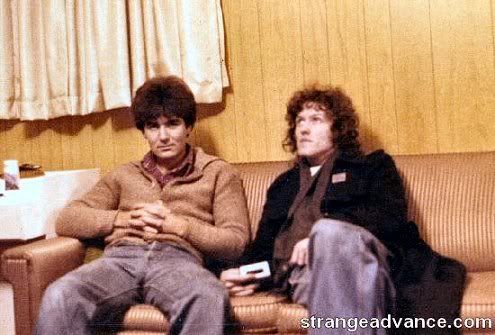
Remind me to go more into depth with that last blog post. I feel there are still major holes that need to be paved over in order for me to be able to fully flesh out the message/manifesto I was trying to convey.
Anyway.
A couple of blog posts back, I mentioned some Canadian New Wave artists whom I felt either deserved a critical re-examination or who were great fun to listen to. One of the ones I lumped into the former category was this group called Strange Advance, out of Vancouver. Formed by Darryl Kromm and Drew Arnott in 1981 from the ashes of a project the two veteran musicians (since 1974 at least) had also been a part of, the band's life span was, like an unstable isotope, quick but with an almost violent energy. Their popularity skyrocketed in Canada from 1983 - 1985 before screeching to a halt and taking a very noticeable nosedive. Interestingly enough, the band suffered a temporary but poignant setback at the beginning of that run when Kromm's father suddenly passed away, and two of the musicians involved with the group drifted away to form their own group, Images In Vogue (hence the artsy subtlety evidenced in both groups).
Before I had heard a single Strange Advance song, back when I was finding out about "obscure" New Wave artists, I saw an article where the group was described as being "a mixture of prog and New Wave". This temporarily put me off wanting to listen to any of their music because I have never been particularly enamored with the prog rock genre. To me it consists of nothing more than an endless array of noodling and instrumentation that goes absolutely nowhere. Think of Boston as your archetypical prog rock group; their recordings lasted seven minutes long on average, and they were noted for extremely lengthy instrumental solos during their live performances. I quickly grow impatient with that kind of meandering nonsense and am very wary of any artist that claims to be even remotely prog. But then I eventually found myself listening to one of their songs ("Love Games") and realized something -- their music wasn't prog at all.
See, I found that Strange Advance performed music that was highly orchestrated, that reached into the stratosphere. Meaning its roots were not in prog but in another rock music phenomenon of the '70s, glam rock. Indeed, "Love Games" is filled to the brim with the indelible influence of David Bowie. "World's Away", their big instrumental, wouldn't sound out of place in a sea of Roxy Music songs. "Home Of The Brave" owes its melodramatic atmosphere to Queen. And some of the guitar lines in some of Strange Advance's rockier songs owe an obvious debt of gratitude to Slade. Indeed, this would fit in with the group's general musical trajectory, coming as it does from a time and a place where glam was king.
I wrote down some notes for this entry at work during lunch and at that time one phrase stuck in my head: "orchestral euphoria". I deduced that that was the key musical difference between glam rock and prog rock. Glam was self-indulgent without being selfish; the musicians might have been having fun building ladders in the sky with gossamer and lace, but at least they did it so they could take the listener on a trip up to the heavens. On the other hand, prog rock floated up high above the earth just to showcase the supposed musicianship of the person playing the instrument. These people sought to be worshipped by the peons down below. And that's where "orchestral euphoria" comes in. See, Queen could be a good example of "orchestral euphoria": multilayered, almost symphonic musical compositions that sought to lift the music listener's spirits. Witness the residual feeling of sheer delight one gets from listening to a Queen song. Then contrast that feeling to the feeling one gets after listening to too much classic rock radio, filled as it is with endless marathons of prog musicians who composed complex instrument lines purely as a method of metaphorical dick-waving, with their instrument used as an extension of their manhood.
Which brings me back to Strange Advance. Their songs don't carry the mark of musicians who are engaged in a battle of "mine's bigger/better than yours" but rather hints of that "orchestral euphoria" mentioned above. Even their most OTT song, "I'll Be The One To Cry", tries so very hard to take the listener along for its magic carpet ride. That is why I feel that it is incorrect to label Strange Advance, or indeed any musical artist who could be credibly slotted into the New Wave category, as being even remotely related to prog. Strange Advance is an example of glam rock meets New Wave, of Ziggy Stardust communicating with Blondie and Elvis Costello and coming up with a formula that works. Tell Major Tom it's okay.
Wednesday, April 25, 2007
My Music Theory: Pop Culture, Disenfranchisement, and New Pop
I have been avoiding this blog recently. After recovering from a particularly difficult few days at last week's end and after finding nothing particularly worth mentioning, it's been a challenge trying to figure out what the next topic of discussion would be. So my task to you is to do some brainstorming: What do you like from the world of New Pop/synthpop? What '80s fashions do you find yourself missing? Any '80s TV/movies fill you with a sense of hope and wonder and excitement (or at least provide you with some substantive thrills)? Pls to mention them here kthx.
Another thing I've been thinking of, and this one's a general one: In times of deepest turmoil, the popular culture often becomes more exciting, more revolutionary, more original. Think of the first British Invasion. The artists and musicians involved in that scene were born at the height of World War II during the Blitz and other bombing campaigns directly targeting the U.K., and spent most of their childhoods living through a period of rationing that didn't end in Britain until ca. 1956. The period of rebuilding after the war likely took longer. So when these children of the destruction heard the barebones workings of primitive early rock & roll, they took that sound and turned it into something catchier, more refined, and poppier, as a subconscious attempt at reworking an immature sound into something more grown-up.
Fast-forward a couple of decades and witness the participants in the so-called Second British Invasion. At the time these artists were recording music, their government was ensnarled in the Falklands conflicts, their economy was in a deep recession, everyone feared the results of a mega-clash between the two sides of the Cold War, and people routinely had nightmares about nuclear strikes wiping out the planet. So in one of the most rebellious statements ever made, these artists combined elements of post-punk, classic New Wave, '60s pop, disco, and funk, and blended them all together to craft a sound that was poppy, peppy, and full of energy. It did not dare mess around by meandering about -- it was straight to the point. Showoffs and musical wankery were both despised and reviled, and bland, naive statements of "we can change the world!" were replaced by oblique lyrics full of imagery as the artists thumbed their noses at easy solutions to difficult times. They figured: Why the hell try to change things when they can only ever be unchangeable? We will choose to live out our days here with as much zeal and gusto as we can, and we will never let the difficult times get to us. Witness the quote from Simon Le Bon -- "We want to be the band that people dance to as the bomb drops." Detractors might view this as nihilism at its most obnoxious, but a realist can and should only view this as the only proper way to go.
Contrast the above with times of relative peace and prosperity, particularly in America, when global issues didn't really start to hit home until the late 1970s. Early '70s American radio played never-ending marathons of the Captain and Tenille, Loggins and Messina, Cat Stevens, Al Stewart, and other artists who were safe, bland, anonymous, dispassionate, almost bucolic. In the mid '70s the arena rocker ruled American airwaves, their musical wankery and pomposity matching the free-wheeling, bombastic spirit of the Me Generation at its selfish and self-centered prime. The soundtrack to the movie FM showcases the worst collaboration between the two aforementioned periods of popular American music, at a time when the only positive American contribution to popular music from 1970 to the present, disco music, was already utilizing the exciting advances in musical technology. In other words, they were quick to welcome the synth.
Disco music is, in fact, the exception that proves the rule. A musical genre whose target audience involved the disenfranchised in American society -- gays and lesbians, transgendered people, racial and ethnic minorities, and women -- its pulsating rhythms and willingness to lead the listener/dancer into a state of oblivion provided a revolutionary wake-up call to groups of individuals who were accustomed to living life on the periphery. The dance floor became a target for pent-up energy and frustration, and it allowed these people to join in with a global community of dancers, artists, and other fabulous people, who all feasted upon the ferocious energy boost that disco gave them. By the end of the 1970s, all of these groups sublimated disco into their consciousness and, though circumstances forced disco to remain underground in the U.S., it never really died off.
The aforementioned circumstances involved anti-disco chants and rants that were more often than not mere window dressings for bigoted thought processes that resided below the surface of the obnoxious young, Caucasian, suburban males who shouted "Death to disco." A few years later, these same men, all grown up and now a part of the power structure in America, targeted the premier element of the Second British Invasion, New Pop (synthpop), and hissed stereotyped and vaguely homophobic remarks in an (eventually successful) effort to wipe the American popular music slate clean of these artists who dared to challenge the dominant musical paradigm. Tying this all back to the original theory, New Pop helped provide entertainment for another group that was effectively disenfranchised in the early to mid '80s -- young teenaged girls. It is telling that only one filmmaker throughout this time spoke the teenaged girls' lexicon: John Hughes, who also made movies for teenaged boys (but with an enlightened spirit that did not objectify the girls therein). These girls, who were also continually frightened by the thought of nuclear war and who were hearing in the news stories of this relatively new phenomenon called "global terrorism", whose main target happened to be U.S. interests, sought New Pop for the same reasons that the men and the women out on the dance floor ca. 1977 sought out disco.
So I suppose, having said all that, that it's no surprise that I too would get wrapped up in New Pop. Since its original purpose was to provide an outlet for young women whose voices weren't being heard or represented in the mainstream, it fits with my own life story. As an American Latina who "came of age" in the 1990s, I can recall not seeing anything in the media that told my own story. The only members of "la raza" who took part in mass media were still the bit players -- the key grips, the best boys, the carpenters, and the like. I cannot recall a single TV or movie star throughout the whole of that decade who looked like me or a member of my family. The music of that time period also did not speak for me. Alternative rock was for the white kids in the suburbs (though as someone who tried so very hard to be white, I did do a good job of mimicking interest in the genre). Rap and hip-hop were for African Americans, whose voices were being heard loud and clear. Dance took on a European flair but quickly became mired in its own repetitiveness; it was more for the drugged-up dancers than for any music listener. Country? I don't think so. So my music-seeking ears picked up very quickly on a genre that had already proven itself to be an effective voice for those without one, and I almost immediately fell in love with New Pop. The highly tailored androgyny spoke well to me in a time when the popular young male pop cultural figures appeared slovenly and full of machismo, and the thoughtful artsiness of the video clips held up very well when compared to the banal performance clips that filled '90s music video television programming.
But I'm going to have to think about this theory of mine some more. I don't know if it's fully fleshed out enough. It does appear to solve a lot of puzzles, though. And I'm hoping that maybe, if it does work out, it will go far in explaining why it is I was drawn to what I was drawn to, even though I've been told for fifteen years that I'm not "supposed" to be drawn to it, either for popularity or critical reasons.
Saturday, April 21, 2007
In A Big Country: Canadian New Wave
At last, a difficult period that ended up lasting me a little under 48 hours is over and done with. My reward is to expostulate on something here on this blog (almost called it a "journal").
What should I talk about now? Maybe I should reveal the name of another track I listened to on that '80s Internet radio program I also discovered (for myself, obv) The Armoury Show's "The Glory Of Love" on, i.e. "Railways" by Kitchens Of Distinction. But having found that the Kitchens Of Distinction were known as sort of a "shoegaze"-type group with a lot of underground critical acceptance, I decided their aesthetic doesn't really fit the overall scene of this blog, though that song did sound really nice in a sort of "imagine the perfect scenario of being in college in 1988 and listening to the most far-out 'modern rock' on the campus radio station" way. I would've totally been okay with being "indie" had it worked out that I'd have been "indie" in the late '80s, after experiencing the joys of super-anthemic synthpop. However, since things DIDN'T end up working out that way and I was thrown into a scenario where "college radio" rock was pretty much more of the same shit I'd been apathetic about (to say the least) since my early adolescence, the indie scene will never gel for me, no matter how many indie acts try now to ape the sound of the early '80s.
So where do these answers lie? Where shall I go? I can always try to rebel by reaching out for something that is completely antithetical to that pristine, serene, intellectual scene, something whose aesthetic is completely everything stereotypically gauche about the '80s without being to the point where even I would roll my eyes and go, "Oh dear Lord, what are they on about?" So no Poison, no Crue, not Ratt or Whitesnake or what have you from the "hair metal"oids whose primary goal was just to score some chicks and booze on the Sunset Strip. No, I think I shall have to look up at the Great White North for my anti-college rock rebellion to be soundtracked.
Yep, that's right. O Canada....
One of the first Canadian artists I can think of for the purpose I seek is the truly cheesy Platinum Blonde. Ah yes, the group led by one former Brit (and boy was it a surprise to find that out) named Mark Holmes and featuring some of the most laughable "mall rat" hairstyles ever showcased on a masculine head, this group did manage to create some pretty sweet tunes. Everyone can recall "Crying Over You" with its big '80s rock sound, all machismo and swagger on the surface but candy-flavored nougat on the inside, but oddly enough, one of their earlier hits, "It Doesn't Really Matter", had quite a lot of that Brit-influenced substance the group had apparently sought. Still, to think of Platinum Blonde as being Canada's answer to Duran Duran would evoke concerns about Canada's ability to respond competently. Doesn't mean it wouldn't keep me from enjoying their music, however overblown the rock might have become.
Then there's a group that truly deserves never to have felt a single moment's cringe, the fabulous Payloa$. People always recall them for their hit "Eyes Of A Stranger", and for good reason, too; the song's reggae-flavored New Wave sound is a perfect exemplar of the group's sound overall. Everything about The Payola$' music is antithetical to Platinum Blonde -- it is subtle and smooth and complex and almost feminine. The real Duran Duran picked The Payloa$ to open for the band during their grand North American stand at Toronto's Maple Leaf Gardens in 1984 during a concert that was taped for commercial redistribution, but that was by no means the band's biggest success point. That would come later, after the group had broken up and the guitarist of the band, one Bob Rock, became an in-demand hard rock/heavy metal producer, producing names such as Metallica. To hear Metallica's music and contrast it with the delicate strumming Rock did as a member of The Payloa$ might lead one to wonder how one might be able to get from point A to point B, but noting that Rock was able to dial down the sound of the fury and come up with something that was still quite powerful does help.
How about Corey Hart? No one has yet to come to Hart's defense critically for his recordings, not even in the era of supposed tearing down of previously held notions about such htings, but I do feel they deserve re-evaluation, particularly his album Boy In The Box, which I feel is a very strong, underrated synthpop delight. There's also the previously mentioned Parachute Club, who spread their almost hippie-like joy north of the border. Images In Vogue are actually perhaps the classiest Canadian contribution to the world of '80s pop music; their icy/classy synthpop could be fooled for being of British origin, it's that good. Martha & the Muffins are another notable example of tasteful Canadian New Wave. Even if every one of their songs had been an "Echo Beach" clone, they'd have had plenty to be proud of. Strange Advance's music revisits the same bombastic territory of Platinum Blonde, but with a lot more subtlety and quality; Strange Advance could have actually been credibly advanced as being Canada's answer to Duran Duran, in fact. Oh, and speaking of artists that could've been fooled for being British, Trans-X's "Living On Video" would have left people puzzling as to how that slice of prototechno was NOT concocted in the U.K.
Regardless of how tasteful, low-key, etc., all that music is, however, it does also provide a good counterpoint to the world of self-importance that the "indie" musical genre has generally resided within. Because of Canada's massive land size (bigger in area that the United States), its music is destined to be equally big and make a huge statement with massive sounds. Even The Payloa$ and Images In Vogue had music that belied the BIG-ness of their originating country, even though their sounds were more low-key and tasteful. And during a time when we are supposed to be starting to celebrate the previously unchampioned while we slough off our old, silly notions of what is to be consisdered critically acceptable, that big sound should and will play a key role in the much-needed new musical revolution.
(God, I hope all of the above makes sense to me when I get some actual sleep in me.)
Saturday, April 14, 2007
'80s Pop Culture In A Fork: My Awesome '80s Diet

Feeling a little on the weak side tonight, so I'll tackle a light topic: Food in the '80s.
Unlike most aspects of '80s living, the food trends of the '80s did hit me right at home. Which meant I spent a lot of time noshing on healthier fare and being aware of diets. It also meant eating that was at the time thought to be attuned to my mother's diabetes. Using margarine instead of butter, drinking diet sodas and sugar-free Kool Aid, having sugar-free Jell-O and Cool-Whip for dessert -- all of that mingled both with the diet-crazed '80s and my mother's doctors' admonitions to follow a healthier diet. Other food trends also made their way into my family's regular food eating. Hamburger Helper, which debuted in the '70s and was many an '80s working woman's savior, was a regular feature for dinner and a cause for celebration for little girl me. Always served with an iceberg lettuce and tomato salad (thousand island and Catalina dressings both available), Hamburger Helper always felt like some reward or special treat and still tastes (to me) like home. (My favorite flavor was always beef stroganoff.)
But back to the sodas -- the first soda I ever drank was TaB Cola. Once the target of ridicule for its distinctive saccarhine taste and even temporarily taken off the shelves when the "saccharine as possible carcinogen" scare was going on, TaB is a sort of acquired taste. You take the first couple of sips of the soda and can't believe anything could taste that bitter or artificial, but then you drink some more and it starts to taste pretty good. Almost fruity, even. By the time you've finished off a can, you can't wait to get into the next one. And that's how it starts. For me, that taste is the taste of my lost childhood, especially since so few retailers these days actually stock it still. I may have moved on to Diet Coke and other diet sodas, but TaB will always be that first soda for me. One look at that ubiquitous pink can and it's instant flashback time to a time when I would come home in my Catholic school girl uniform, peel off my sweater and skirt, take my penny loafers off, walk around in my school shirt and the shorts I wore under the skirt, grab a TaB from the fridge, and sip away as my parents started on dinner.
This is not to say that my childhood was sugar-free. Oh no. I too enjoyed cookies and pie and cake and ice cream. It's just -- I remember them being more "occasional" foods, goodies eaten during special occasions or every once in awhile. And I don't remember seeing them all that often around the house. Usually when I would eat cookies they were store-bought. Same with pies, though at least you had to bake them at home (oh Mrs. Smith's, where would my childhood be without you?). Cake came from a mix. And ice cream was a rare treat indeed, usually reserved for the once-monthly trips to McDonald's where, if I was good, I would get a small strawberry sundae or maybe even a cone. Usually what constituted as "ice cream" around the house was actually sherbet, predominantly the peach or pineapple flavors. Sherbet, touted in Mom's diet books as being a healthier alternative to ice cream, is now something I don't really crave, having converted to the dark side of ultra-creamy ice cream.
Not all of my old food biases from the '80s have been converted. For example, I still can only stand just a little bit of butter in my food. I still feel strongly that the taste of margarine is actually a "buttery" taste and cannot comprehend anti-margarine bias. I don't really know what cake made from scratch tastes like and don't have that curiosity thanks to Betty Crocker. My blood runs cold whenever anyone laughs at the concept of Hamburger Helper or TV dinners or anything else that was meant to be a quick fix and eat type dinner concept. I'll only drink regular sodas if I'm having to work a graveyard shift (so I can stay awake better) and can't fathom drinking those all the time, I in fact find a lot of things "too sweet", and I wonder how certain families could afford having a parent stay at home long enough to fix a fully home-prepared and -cooked dinner every night and secretly wonder if those "like Mom/Grandma used to make" families have been solidly middle class for generations.
I guess that's what my '80s really boils down to as far as food goes. See, I was still living in a solidly blue-collar, lower middle class socioeconomic ring during that decade, and I know for a fact both my parents worked outside the home on a full-time basis because they couldn't afford to do otherwise. By the early '90s, which is when my parents moved up in their respective jobs (my mom with the most impressive leap, comparatively), we were finally able to work towards entering the regular middle class and that's when we started broadening our food horizons. But a lot of the "from scratch" food nostalgia that gets propagated by the food-oriented mass media comes from a background of generations of solidly middle class families, whose female members were historically able to make the time and effort to making things such as pie crusts and homemade cookies and who passed that down to the proceeding generation. The '80s was one historic moment when all of that really didn't make that much of a difference because everyone was busy and convenience (and affordability) reigned. But by the time the true cultural '90s rolled around and people started murmuring about going back to their "food roots", the fissures in the pavement started to show and it became more obvious who was working hard in the '80s because they wanted to, and who was working hard because they HAD to.
So I will continue to enjoy Cool Whip (that's another thing -- I've never had "fresh sweet whipped cream" before) and sugar-free Jell-O. I will continue to insist on buying pre-made pot pies and cookie dough to bake up in the oven and ooh and aah at the results. I will drink my TaB and eat oat- and fiber-rich cereals and find no difference in the pleasure values between those and the sugary "kid" cereals that cost just as much. I will not have bread snobbery except for the recent development of my preferring whole wheat bread to regular white. I will enjoy iceberg lettuce and tell everyone about that. I will refuse to stop feeling more comfortable with the taste of margarine than I am with the taste of butter. And I will eat premium ice cream with the knowledge that my dessert is a luxury, not a necessity, and that I would've never gotten to eat that when my age was in the single digits.
(Wow, two serious posts in a row. I must be going for some record here.)
Friday, April 13, 2007
Statement Of (Blog) Being, Part 3
I am tired, so I think I'll go off on little tangents. Hopefully one of them will stick.
Why do I love synthpop/'80s "New Romantic" music/synth rock so much? I suspect part of it has to do with a certain sort of exoticism. Because I come from cultures where that sort of cold synth sound is absent or undervalued, there's a sort of unknown geography going on there. Or maybe it's because it's all so immediate. Or....
You know, I was thinking about something this morning on my drive to work. I kept on thinking about how we as Americans hate fun. We are fun haters. We cannot stand the idea of anyone having real, genuine, organic fun, and so we try to destroy as many "fun" outlets as possible. In the '60s, it was okay to have fun because there was an overwhelming abundance of young people who thought nothing of having fun (and also thought nothing of the future consequences for this "fun"), but by the early '70s fun was completely out of the equation, replaced instead by musical wankery. The musical equivalent of trying to see who has the bigger dick, the overnoodley arena/album rock that was in vogue throughout the American '70s delivered nothing but endless instrumental solos and caused lots of (predominantly) male audiences to feel self-important as they beat their chests and hollered at the fantastical extension of their own manhood. Glam rockers tried valiantly to funnel some of that attention their way but got practically nowhere in the States, the odd occasional megahit notwithstanding.
By the late '70s, three separate musical revolutions, two of which emerged from the U.K. and one that was homegrown, conspired to try to shake up the world of music. The British twosome, punk rock and a genre called New Wave, both sought to simplify the performance and writing of rock music, distilling it to its very essence. Punk brought back the rebellious sneering and attitude that made rock & roll dangerous in the eyes of the '50s Establishment, while New Wave went back to the formula that won American audiences over to the artists of the '60s British Invasion. The American rebellion took the form of a more danceable version of funk called disco; largely faceless artists (though there were a few luminaries in the genre) performed music mostly written by others that caused people to have fun, lighten up, get over themselves, and just have a good time. Though it could've been considered prefabricated pop, it differed from the cookie cutter assembly line teen pop of the early '70s by actually being an outlet for these musicians' and composers' artistic expressions. Soon punk rock and disco merged into another musical genre altogether, post-punk, which later fused with original New Wave to create the iconic '80s New Wave sound most people can readily point out.
None of the above were fully accepted in the U.S., though, again because we hate fun. Oh no, we weren't going to invest the time to figure out literate irony and sly cheekiness in our American version of punk; no, American punk had to be yet another outlet for Neanderthal macho posturing, with shirtless males from the suburbs growling into the microphone or noisily destroying their guitars (and their listeners' eardrums). As for original New Wave? Heck no, we won't stand for that kind of business. Those musicians look like they're having the time of their lives performing catchy songs with poetic lyrics! No, we have to have our musicians be absolutely morose and miserable-looking. We have to have songs that we have to suffer through. And heaven help us if our musical lyrics are either spelled out for us or deliberately obtuse via the prolific use of mind-altering substances. As for disco -- well, please, we are not going to stand for a multicultural, multisexual audience actually comingling on the dance floor in a TRULY united nations manner. We'll just make vaguely homophobic remarks and pretend disco is all about the novelty songs written by people trying to cash in on disco. No, we'd rather have anguished troubadors whining on about their lost childhoods while strumming passionlessly on their (acoustic) guitars because all we want to feel is RAGE RAGE RAGE! No love, no serenity, we want to RAGE ON.
So when '80s New Wave/New Pop music (what the synthpop of the '80s was known as) became all the rage amongst early '80s American adolescents, when the most vital American DJs were the ones who were championing this largely British musical format (i.e. Rodney Bingenheimer and Richard Blade), when teenaged boys and girls were having fun listening to music that was a mixture of British punk's DIY aesthetic and winkily witty lyricism, disco's catchiness and emphasis on a strong rhythm section, and original New Wave's insistence on a return to musical simplicity and tightness in chord structure, the American musical establishment could not recoil fast enough. Oh no, these overgrown hippies and stoners exclaimed, our youth of today are having fun with music that could actually be considered revolutionary! They might steal our late '60s counterculture thunder! So they called in Greil Marcus and Dave Marsh and the rest of America's most prominent music journalists to make sure that '80s New Wave/New Pop got quashed but good, which it was by the time 1987 rolled around. By that time, music became severely ghettoized once again, leaving few choices for anyone who wanted anything that was as much a breath of fresh air as New Pop was. (Interesting note: By 1989, the only artist to have that sort of witty, fun-loving spirit was the U.S.'s They Might Be Giants.)
After suffering through the 1990s and the first couple of years of the millennial decade, i.e. the nadir of popular music overall, indie/college artists worldwide rediscovered the joy and exhiliaration of the music that caused the Rolling Stone magazine set to quake in its moldy old boots. They found that punk could sound like something other than a bunch of hypertestosteroned yelping. They discovered the joys of disco dancing with a technological bent that would make Tubeway Army smile. They realized that "New Wave" wasn't the slur they were raised to believe it was. And they found that post-punk was the absolute mark of perfection in the world of '70s pop music. Now even '80s New Pop is getting a reexamination, albeit from artists that are new to the point of being unsigned. The problem with the giant bulk of those artists is that they have yet to reap any real financial or popular rewards for their efforts. They've been getting lots of adoration from the college campus set, but the American Top 40 is still being hijacked by the same ghettoized contrivances that have held popular radio prisoner for the past ten years.
So now what? What I'm thinking is that there needs to be a real critical revolution that goes on. Not from the British, for they will support anything with a real organic intensity and committment to the art of music as long as it isn't too much of a commercial success; indeed, the "Tall Poppy Syndrome" as called out by Australian celebrity journalists toward Aussie celebs has its roots in British music journalism. It is the American music journalism establishment and other journalists influenced by same who continue to enact an unspoken policy of a lack of support for that which did not originate for the Baby Boomer generation. A few lesser-known members of the U.S. musical press are a part of the much-needed revolution, but there still needs to be more support, particularly from the most egregious offenders, Rolling Stone and Entertainment Weekly. And there needs to be more of the music consumers' money devoted to that which sought to involve music in a new revolution -- one that would embrace synths, one that would see nothing wrong in urgent disco beats, one that would put to rest the hoary old sound of a thousand souls dying.
I am but one person, and a mere music listener/consumer at that. But I will do my best to get the ball rolling.
(Wow, I actually made a point tonight. Impressive.)
Thursday, April 12, 2007
From The Vault: Scars' Author! Author!
I've been incredibly derelict with this blog lately, so I shall have to play catch-up.
What I've been listening to recently: I don't know, a lot of stuff really. I suppose the most recent CD I spinned could be a start, and that would be the utterly brilliant reissue of the Scars' Author! Author!. Now I know they don't necessarily fit into the overall schematic of this blog because they were highly critically adored throughout their existence and have continued to receive positive attention from All The Right People, but the simple fact that I discovered them through the New Wave Outpost's "Song Of The Week" super-obscuro New Wave feature will lead one to believe that they were at least COMMERCIALLY underrated.
Seriously, babes. They should have been Scotland's answer to Duran Duran. From me, that's a massive compliment, as I view Duran Duran to be the absolute gold standard acme of what is great about catchy pop music. The Scars performed music quite like that, with a little more of an anarchic punk spin; their songs were a little more primal and urgent and raw. But their last and most well-known single "All About You" wouldn't have been out-of-place on a compilation next to Simple Minds' "All The Things She Said" and "China" by Red Rockers, which is why that is the song most NWO regulars and others coming across that band from a New Wave standpoint remember that song.
I, however, think that only partially tells the musical story of a band whose extraordinary precociousness is rivaled only by their drive, passion, and determination in all they did and have done. With the average age of the individual band members not even 18 at the time of the band's 1977 formation, all four bandmates brought with them impressive resumes. Lead guitarist Paul Research and bassist John Mackie (both brothers) were both classically trained musicians before getting into rock music in their early teens, lead singer Robert King started his music career at the tender age of 12, and teenaged Calumn Mackay was already a veteran of various bands. Immediately upon the band's formation, all four boys committed themselves seriously to writing music and performing gigs and soon began attracting a small but loyal fanbase as they almost singlehandedly established punk in their native Edinburgh.
By the time the band got started on writing songs for the album Author! Author! their sound had mellowed and matured into something more authentically post-punk -- a comingling of raw punk verve and catchy disco grooves. And that's what most of the music on the album sounds like. However, with "All About You" the band landed on a new, even poppier sound, something with all the passion and intensity one might expect from a Scars track but with a preternatural maturity in its execution and delivery. Had the band continued on this musical track for a followup album, their fanbase would have grown exponentially, and had they released yet another album no one would have dared forget them. After five albums, people would be calling them "Scotland's answer to Duran Duran" and they, not the Simple Minds, would have become the biggest Scottish pop group of the '80s. Which could've turned out to be not quite as good a thing as that seems.
See, the individual band members (including second drummer Steve McLaughlin) have managed to do very well for themselves post-Scars, continuing with their lifelong pattern of impressive accomplishments. Robert King, who learned Greek at the almost literally unbelievable age of 10, has continued to showcase his talent for languages as a Ph.D. holder/expert on ancient languages. Paul Research is continuing to make and perform both popular and classical music, runs marathons, and works a decidedly white collar IT job. John Mackie owns his own design firm. Calumn Mackay is a physicist and engineer who continues to play drums in blues and rock bands in his Grenoble (France) home. And Steve McLaughlin is an in-demand record producer and engineer, working with artists such as Sting and Badly Drawn Boy and winning a Grammy (of all things) for his work on a Tom Petty album.
Perhaps it might have been a curse for a group such as this to have become wildly popular. Maybe they would have felt an intense frustration from the constraints such a life trajectory would have provided. But it would've also meant people such as myself, living an ocean, several thousand miles, and decades away, would have been able to get aboard their fan train a lot easier. I know, I know, that's selfish thinking, but after becoming very acquainted with the band's music, I am puzzled as to why a group with that amount of talent should have had to lie dormant at the bottom of the music history ravine. The fact that they were only there because of the brevity of their recording history is a consolation.
Subscribe to:
Posts (Atom)
