In a world where people strain their brains for a lifetime figuring out the next thing to write....
Okay, so I only just now figured out the next topic I'll be tackling on this blog o' mine, and this topic hits especially close to home. See, I was looking back at some of the complaint-based things I've stated in the past and one common theme/thread appears to be running through all of those complaints: Why aren't you taking Duran Duran seriously?
Seriously, Duran Duran are the reason why I'm as much of a music fan as I am in the first place. They are the deeply rooted motivator behind every single post I've been making and will be making on this blog, even when said subject matter might not appear to be even remotely relatable. Duran Duran helped drag me away from a period of my life when I was just going along with whatever my parents liked, and helped me in the development of my own musical tastes separate from my parents'. Virtually anything and everything I've enjoyed listening to from the day I purchased Rio at a secondhand music store in the winter of 1991 onward is because of Duran Duran. And I'm not about to stop acknowledging that, even as I'm now witnessing them making some huge missteps that have caused me to lose a great deal of my faith in them.
Yet I don't know of a single location online, not a single resource or critical voice or someone who just Takes Music Seriously who is ready and willing to defend Duran Duran or to explain why people should take their career oeuvure (sp?) seriously. I think Steve Malins attempts to do this with his latest book, and George Gimarc almost touches on a sort of defense when he references the band in his book on post-punk, but not even Simon Reynolds, who puts up an impressive defense of the New Pop genre that Duran Duran were slotted in during their commercial heyday, does an adequate job of really destroying the destructive myths surrounding the band. And while you might see an occasional glimmer of hope here and there, it still doesn't even begin to have the kind of might that would be needed to combat the decades of critical dismissal of the group, even when the group were at their most admirably envelope-pushing and, dare I say it, experimental. If I read something online that states something positive about the band, it usually comes from a perspective deeply rooted in their stereotyped image as a teen idol group. (Perhaps a part of the blessing in disguise that is the Scars' lack of commercial success is the fact that they most certainly would have had success as teen idol figures, with their considerable music talents ignored in favor of their physical attractiveness.)
I can always sense it: Someone will point out a blog link to something that discusses Duran Duran in a praise-filled manner, and I will bet on the author of said piece to claim to have been a fan of the group's back in the early '80s, to talk about how she (it's usually a "she") had a crush on [insert Duran Duran band member here] back when she was a teenager, how she just loved the group's music back in the '80s but stopped listening to them in 1987/1988, how she was only slightly aware of their 1993 commercial resurgance but when she heard about the "original Fab Five" lineup reuniting in 2001 it compelled her to revisit the band, how much the group's newest music reminds her of her teen years, and how "weird" she finds the band's musical output from the late '90s to be. And if I were a betting woman, I would make so much money off asserting that that template would be the one that was being followed that I could afford plane fare to visit all of these overgrown adolescents, personally smack them upside the head, and curse them out for undoing all the hard work I've done in the past in proving that you can adore Duran Duran's music without devolving into silly adolescent giggling nonsense.
Also, I get incensed by these girls (ok, sometimes the offending figure is a boi) because they are the very definition of a fair-weather fan, which I am by no means interested in even dealing with. These people appear only to like a musical artist when it's commercially/critically acceptable to do so, and at the very moment said musical artist's star/estimation falls, these people just cut and run. Okay, so maybe it does have its benefits -- I wouldn't have nearly the amount of Duran Duran-related paraphernalia, including all of those cassettes and vinyl I've picked up from secondhand outlets throughout the years, but it gets so frustrating to me to have to deal with a constant editorial assault from these people, who automatically want to lay claim on Duran Duran as if they're the OG fanbeings and anyone who got into the group post-1986 is just a neophyte loser who doesn't deserve to be called a true fan. I mean, like, WHATEVER you stupid bitchlet, *I* was the one who spent days obsessing over an eBay auction in hopes of winning something Duran Duran related. *I* was the one who stuck by the group, year after year, when no one else appeared to even want to be associated with them. *I* was the one who spent hours fast-forwarding through shitty VH1 music video programming (that "The Big '80s" program stank to high heaven, didn't it?) just to see if maybe they'd play a Duran Duran video. *I* was the one who ran home from school her senior year of high school to see a glimpse of Duran Duran on Rosie O'Donnell's old talk show. You got to connect with many, many contemporaries who shared your brand of Duran Duran fanhood, while I had to be the odd duckling who liked "some group called Duran Duran" whom almost none of her classmates had even heard of. During a time period when you were busily denying you ever found any real enjoyment in the band's music, I might add.
So I'll attempt to wrest away the attention and spotlight away from these non-fans and try to posit my arguments for why someone such as myself, someone who feels like she takes music very seriously, would consider Duran Duran to be her gold standard for what she looks for in terms of contemporary/popular music. Even though -- now, this is the real killer here -- even though the band have been practically bending over backwards for the past six years or so to try to appease those little dipshit fair-weather fans. And okay, so the raw materials that made up the songs on that album Astronaut were really, really good, but seriously, I would still take Medazzaland any day of the week over that album, and this next album they'll be releasing soon is going to be the first album of theirs I have committed myself to never owning, not even if I find it on sale for $1 at some clearance sale. And no amount of convincing will make me change my mind about that. But I still cannot escape the fact that Duran Duran have remained influential in my music-listening life for as long as they have, and that I've been a member of their fan ranks for well over half my life. And yes, I still consider myself a fan of theirs.
More tomorrow.
Sunday, May 6, 2007

Thursday, May 3, 2007
MOJO magazine review of the Scars' _Author! Author!_
Scars, Author! Author!
**** (out of *****)
(Previous)
"Long-lost classic from exquisite Edinburgh new pop pioneers."
After being the first group to fuse populist disco and punk, and inspiring a Scottish pop explosion (Postcard, Associates, Fire Engines, etc.), Scars lost momentum due to major-label politics. So Author! Author! was a spectacular return for the summer of new pop in 1981. For many it was the best record of that summer. The fabulously flamoyant Scars' widescreen pop drama mix Funkadelic fluidity with the steely seduction of Siouxsie And The Banshees. The irrepressibly brash Bobby King's Edinburgh burr still steems audacious, as does the production by Penetration's Robert Blamire, while Paul Research was as much the era's guitar hero as John McGeoch and Keith Levene. The centrepiece [sic] of this set remains All About You, and anyone who's ever had their heads turned by the swagger of the Stone Roses should start again with this arrogantly gargantuan tune.
(written by Kevin Pearce for the May 2007 issue of Mojo)
**** (out of *****)
(Previous)
"Long-lost classic from exquisite Edinburgh new pop pioneers."
After being the first group to fuse populist disco and punk, and inspiring a Scottish pop explosion (Postcard, Associates, Fire Engines, etc.), Scars lost momentum due to major-label politics. So Author! Author! was a spectacular return for the summer of new pop in 1981. For many it was the best record of that summer. The fabulously flamoyant Scars' widescreen pop drama mix Funkadelic fluidity with the steely seduction of Siouxsie And The Banshees. The irrepressibly brash Bobby King's Edinburgh burr still steems audacious, as does the production by Penetration's Robert Blamire, while Paul Research was as much the era's guitar hero as John McGeoch and Keith Levene. The centrepiece [sic] of this set remains All About You, and anyone who's ever had their heads turned by the swagger of the Stone Roses should start again with this arrogantly gargantuan tune.
(written by Kevin Pearce for the May 2007 issue of Mojo)
Wednesday, May 2, 2007
The Theory Of (My) Musical Adoration
I swear to you that I was going to post something last night, but then my computer froze up and I had to reset and by the time everything was cleared up I was dead tired and -- ah, it was all a huge mess. But thankfully I managed to save some of what I was going to talk about so the next time the occasion strikes, I can discuss what it is that I was going to discuss. Now on with the show.
I was experiencing a little bit of a continuing crisis of identity last night as well, which was actually my main impetus for wanting to contribute something herein, but now I know what exactly to contribute to combat this. See, I keep on thinking that I'm not "supposed" to like what I like about music, but now, after another day's worth of musing over these thoughts, I realize that I'm listening to exactly what I should be listening to with the background that I have. And I know I'm doing a lot of repetition herein, but I feel like this is a continuation of a topic I just barely touched upon in a prior posting. In fact, I think I didn't actually cover this so much as just hint at it.
Okay. Now. Let's look at some of the major characteristics of the electronic-flavored synthpop/New Wave music from around the beginning of the 1980s. It modeled itself primarily from the punk DIY ethos, which democratized the music-making process. This actually allowed for just about anyone to become involved with the art of creating music, which is perfect for someone with my background, seeing as though I don't come from a sociocultural/-economic background that would lead me to be a part of the actual power structure here in the U.S., or even in my home state. This freedom from the elitist constraints of the past is freeing to me. Then there's the injection of a healthy dose of funk/disco rhythmic action that appeals to the innate rhythm that resides deep within my Latina self. Try as one might, one cannot escape one's cultural/ethnic makeup as an influential force upon one's personal tastes.
And then there's the simple fact that this brand of synthpop/New Wave utilized then-emerging synth technology, in particular synths that were being made for the consumer market. The synth was the premier(e) instrument for a new era that dawned toward the middle of the 1970s, a post-Industrial era where the computer would reign supreme and technology, not industry, would be the primary focal point. In this era, the traditional epicenters of industry are slowly decreasing in importance as high-technology sectors in the regions of the country that have traditionally been disenfranchised, including the U.S. Southwest, have been making steady gains in their overall importance. This means that as we move further into the era of technology, those groups who have maintained a foothold on that region of the country, including the also disenfranchised Americans of Mexican descent (disclaimer: I am one), will also increase in importance. Already you are seeing the signs of this on one major national network, ABC -- "The George Lopez Show", "Desperate Housewives", "Ugly Betty", and "Grey's Anatomy" all feature Latinos as part of the central cast, and its news department consists of Latino news luminaries such as Elizabeth Vargas, John Quinones, Jim Avila, and Taisha Hernandez. Now, you may not think this could be relatable to the lowly synth, but if you'll note that the synth is the hallmark instrument for these new technological times, where knowledge is truly power and meritocracies can finally be instituted in place of sheer good fortune and power plays, then the synth is the ideal instrument for a time when people who look the way I look can finally realize their own destinies, and musicians who were synth pioneers, including Ultravox and Gary Numan's Tubeway Army, can and should be viewed as the new Beatles or the new Elvis.
So. I think I've made up my mind. It is completely natural for me to fall in love with music that places importance on this relatively new synth technology, to actively seek out mini-Moogs and/or Fairlights in my music. Since I am all about claiming a slice of the pie that will be dished up to myself and my kind when we as Americans can finally bury the last shuddering remnants of the Industrial Revolution, it would be natural for me to embrace the instrument that is symbolic of the new era of long-awaited progress and development for myself and my people. It's natural for me to fall in love with music that is rhythmically danceable, as that tribal beat is ingrained in my DNA. And the no-nonsense, anti-elitist punk DIY ethos fits perfectly with my blue collar roots. Hence, I feel that my musical tastes should not be viewed as surprising or antithetical to the being I am at the core. Wow. This theory (as it's still just a theory) totally works for me. Does it work for you?
I was experiencing a little bit of a continuing crisis of identity last night as well, which was actually my main impetus for wanting to contribute something herein, but now I know what exactly to contribute to combat this. See, I keep on thinking that I'm not "supposed" to like what I like about music, but now, after another day's worth of musing over these thoughts, I realize that I'm listening to exactly what I should be listening to with the background that I have. And I know I'm doing a lot of repetition herein, but I feel like this is a continuation of a topic I just barely touched upon in a prior posting. In fact, I think I didn't actually cover this so much as just hint at it.
Okay. Now. Let's look at some of the major characteristics of the electronic-flavored synthpop/New Wave music from around the beginning of the 1980s. It modeled itself primarily from the punk DIY ethos, which democratized the music-making process. This actually allowed for just about anyone to become involved with the art of creating music, which is perfect for someone with my background, seeing as though I don't come from a sociocultural/-economic background that would lead me to be a part of the actual power structure here in the U.S., or even in my home state. This freedom from the elitist constraints of the past is freeing to me. Then there's the injection of a healthy dose of funk/disco rhythmic action that appeals to the innate rhythm that resides deep within my Latina self. Try as one might, one cannot escape one's cultural/ethnic makeup as an influential force upon one's personal tastes.
And then there's the simple fact that this brand of synthpop/New Wave utilized then-emerging synth technology, in particular synths that were being made for the consumer market. The synth was the premier(e) instrument for a new era that dawned toward the middle of the 1970s, a post-Industrial era where the computer would reign supreme and technology, not industry, would be the primary focal point. In this era, the traditional epicenters of industry are slowly decreasing in importance as high-technology sectors in the regions of the country that have traditionally been disenfranchised, including the U.S. Southwest, have been making steady gains in their overall importance. This means that as we move further into the era of technology, those groups who have maintained a foothold on that region of the country, including the also disenfranchised Americans of Mexican descent (disclaimer: I am one), will also increase in importance. Already you are seeing the signs of this on one major national network, ABC -- "The George Lopez Show", "Desperate Housewives", "Ugly Betty", and "Grey's Anatomy" all feature Latinos as part of the central cast, and its news department consists of Latino news luminaries such as Elizabeth Vargas, John Quinones, Jim Avila, and Taisha Hernandez. Now, you may not think this could be relatable to the lowly synth, but if you'll note that the synth is the hallmark instrument for these new technological times, where knowledge is truly power and meritocracies can finally be instituted in place of sheer good fortune and power plays, then the synth is the ideal instrument for a time when people who look the way I look can finally realize their own destinies, and musicians who were synth pioneers, including Ultravox and Gary Numan's Tubeway Army, can and should be viewed as the new Beatles or the new Elvis.
So. I think I've made up my mind. It is completely natural for me to fall in love with music that places importance on this relatively new synth technology, to actively seek out mini-Moogs and/or Fairlights in my music. Since I am all about claiming a slice of the pie that will be dished up to myself and my kind when we as Americans can finally bury the last shuddering remnants of the Industrial Revolution, it would be natural for me to embrace the instrument that is symbolic of the new era of long-awaited progress and development for myself and my people. It's natural for me to fall in love with music that is rhythmically danceable, as that tribal beat is ingrained in my DNA. And the no-nonsense, anti-elitist punk DIY ethos fits perfectly with my blue collar roots. Hence, I feel that my musical tastes should not be viewed as surprising or antithetical to the being I am at the core. Wow. This theory (as it's still just a theory) totally works for me. Does it work for you?
Saturday, April 28, 2007
Immediate Reaction: Hubert Kah, "The Picture"
GAH.
First off, my terrible insomnia problem strikes yet again. After spending nearly an hour trying to fall asleep, I took out my iPod and picked a random song to listen to. Having loaded up the RetroActive 5 compilation because of its Seona Dancing, Strange Advance, Blancmange, and Psychedelic Furs remix components, I was surprised to find my iPod start to play one of the songs off the compilation I had never heard before: "The Picture" by Hubert Kah. I had never even heard of Hubert Kah before, but it sounded European so I figured, eh, it should be good for a trial.
This is one of those kinds of songs I obsess over. It happens every now and again -- one of the more recent and memorable occasions happened when I latched so strongly onto "Alles Klar" by Ultravox that I could not get enough of it, even after playing it some 25 times in a row on two separate occasions, in as many days. I committed myself to learning every nuance, every corner, ever nook and cranny of that wonderful, haunting instrumental. Eventually I got my fill, but not without playing it some 100 times in a one-week span. "The Picture" has that very quality.
First off, I will admit to having my weak points. Icy cold synth lines? Check. Minimalist bass sound? Check. Delicate yet highly urgent staccato rhythm that evokes a sort of Italo disco influence/sound? Check. Very Continental European breathy synth-dance male vocals? Check. "The Picture" has all of the above. "The Picture" evokes nearly all of my weaknesses. It even makes good use of a church bell sound effect that also evokes a cold Europeanness to the track's overall atmosphere, that makes it even that much more appealing to me. Even the rock guitar solo toward the middle of the song, something I don't generally go for, has a sort of detached passivity in its very being that makes it not so much a macho act but rather something that helps drive the song along.
I was roused enough by this song to jump out of bed and do a quick Google search for more information, where I found my European suspicious confirmed. Hubert Kah were apparently a German synth group that existed as recently as the late '90s, though I didn't really check too close to see when their latest recordings were released. The band released the original track from whence "The Picture" sprung forth, "Wenn Der Mond Die Sonne", in 1984, and I imagine "The Picture" was released not long after that. And -- oh, the shame -- it (the English-language version of the song) even appeared on the soundtrack of the critically-panned (for good reason, I've been reliably told) mid '80s flick Once Bitten. What is it with crap mid '80s movies and great songs therein? No one can honestly say that the Rodney Dangerfield vehicle Back To School was good even as a "so bad it's brilliant" type movie, yet its soundtrack featured the utterly breathtakingly great "Dead Man's Party" by Oingo Boingo.
As of yet I still really don't know all that much about Hubert Kah except that the band members were German, their producer and "arranger" (don't know what exactly that means) was from Bucharest, Romania (yay Romanians!), they wrote songs for other people, presumably German pop stars, and the great majority of their output was written in German, as befit their target demographic and largest audience. Unlike their fellow Germans in Alphaville, they apparently either had no real designs for the international, English-speaking marketplace, or their music (this would be sad if it were true) didn't take off and they ended up retreating back to their German roots.
Oh well then. The damage has been done. I am swooningly in love with YET ANOTHER SONG and I will have to play this song at least 100 times this week before I get my fill, I'm sure. And now I know I can't sleep. I have to listen to this song some more. It's gripping me so very tightly and pulling me away from my slumber and into its hypnotic vortex. This is how it all gets started, people.
Edit: OH MY GOD this track features the LINN DRUM. THE LINN DRUM, people, the synth drum that delivered that oh-so-'80s percussion sound that I ADORE. And the rhythm isn't so much staccato-ish on the surface as it is, um, restrained. But there IS a rhythmic synth sound that lays sorta in the background that IS staccato-ish, that does provide the track with some of its danceable drive and energy. But -- THE LINN DRUM! I wonder now if the synths on this track are Fairlights. They could be. OMG what if they are?? Especially if the synths were Fairlight CMIs. Then I'd know for sure it was destiny that I fell in love with this track. Either that or that I was awfully predictable. Heh.
First off, my terrible insomnia problem strikes yet again. After spending nearly an hour trying to fall asleep, I took out my iPod and picked a random song to listen to. Having loaded up the RetroActive 5 compilation because of its Seona Dancing, Strange Advance, Blancmange, and Psychedelic Furs remix components, I was surprised to find my iPod start to play one of the songs off the compilation I had never heard before: "The Picture" by Hubert Kah. I had never even heard of Hubert Kah before, but it sounded European so I figured, eh, it should be good for a trial.
This is one of those kinds of songs I obsess over. It happens every now and again -- one of the more recent and memorable occasions happened when I latched so strongly onto "Alles Klar" by Ultravox that I could not get enough of it, even after playing it some 25 times in a row on two separate occasions, in as many days. I committed myself to learning every nuance, every corner, ever nook and cranny of that wonderful, haunting instrumental. Eventually I got my fill, but not without playing it some 100 times in a one-week span. "The Picture" has that very quality.
First off, I will admit to having my weak points. Icy cold synth lines? Check. Minimalist bass sound? Check. Delicate yet highly urgent staccato rhythm that evokes a sort of Italo disco influence/sound? Check. Very Continental European breathy synth-dance male vocals? Check. "The Picture" has all of the above. "The Picture" evokes nearly all of my weaknesses. It even makes good use of a church bell sound effect that also evokes a cold Europeanness to the track's overall atmosphere, that makes it even that much more appealing to me. Even the rock guitar solo toward the middle of the song, something I don't generally go for, has a sort of detached passivity in its very being that makes it not so much a macho act but rather something that helps drive the song along.
I was roused enough by this song to jump out of bed and do a quick Google search for more information, where I found my European suspicious confirmed. Hubert Kah were apparently a German synth group that existed as recently as the late '90s, though I didn't really check too close to see when their latest recordings were released. The band released the original track from whence "The Picture" sprung forth, "Wenn Der Mond Die Sonne", in 1984, and I imagine "The Picture" was released not long after that. And -- oh, the shame -- it (the English-language version of the song) even appeared on the soundtrack of the critically-panned (for good reason, I've been reliably told) mid '80s flick Once Bitten. What is it with crap mid '80s movies and great songs therein? No one can honestly say that the Rodney Dangerfield vehicle Back To School was good even as a "so bad it's brilliant" type movie, yet its soundtrack featured the utterly breathtakingly great "Dead Man's Party" by Oingo Boingo.
As of yet I still really don't know all that much about Hubert Kah except that the band members were German, their producer and "arranger" (don't know what exactly that means) was from Bucharest, Romania (yay Romanians!), they wrote songs for other people, presumably German pop stars, and the great majority of their output was written in German, as befit their target demographic and largest audience. Unlike their fellow Germans in Alphaville, they apparently either had no real designs for the international, English-speaking marketplace, or their music (this would be sad if it were true) didn't take off and they ended up retreating back to their German roots.
Oh well then. The damage has been done. I am swooningly in love with YET ANOTHER SONG and I will have to play this song at least 100 times this week before I get my fill, I'm sure. And now I know I can't sleep. I have to listen to this song some more. It's gripping me so very tightly and pulling me away from my slumber and into its hypnotic vortex. This is how it all gets started, people.
Edit: OH MY GOD this track features the LINN DRUM. THE LINN DRUM, people, the synth drum that delivered that oh-so-'80s percussion sound that I ADORE. And the rhythm isn't so much staccato-ish on the surface as it is, um, restrained. But there IS a rhythmic synth sound that lays sorta in the background that IS staccato-ish, that does provide the track with some of its danceable drive and energy. But -- THE LINN DRUM! I wonder now if the synths on this track are Fairlights. They could be. OMG what if they are?? Especially if the synths were Fairlight CMIs. Then I'd know for sure it was destiny that I fell in love with this track. Either that or that I was awfully predictable. Heh.
Thursday, April 26, 2007
Strange Advance And The Prog vs. Glam Debate
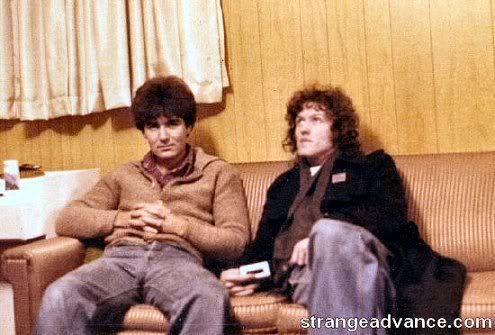
Remind me to go more into depth with that last blog post. I feel there are still major holes that need to be paved over in order for me to be able to fully flesh out the message/manifesto I was trying to convey.
Anyway.
A couple of blog posts back, I mentioned some Canadian New Wave artists whom I felt either deserved a critical re-examination or who were great fun to listen to. One of the ones I lumped into the former category was this group called Strange Advance, out of Vancouver. Formed by Darryl Kromm and Drew Arnott in 1981 from the ashes of a project the two veteran musicians (since 1974 at least) had also been a part of, the band's life span was, like an unstable isotope, quick but with an almost violent energy. Their popularity skyrocketed in Canada from 1983 - 1985 before screeching to a halt and taking a very noticeable nosedive. Interestingly enough, the band suffered a temporary but poignant setback at the beginning of that run when Kromm's father suddenly passed away, and two of the musicians involved with the group drifted away to form their own group, Images In Vogue (hence the artsy subtlety evidenced in both groups).
Before I had heard a single Strange Advance song, back when I was finding out about "obscure" New Wave artists, I saw an article where the group was described as being "a mixture of prog and New Wave". This temporarily put me off wanting to listen to any of their music because I have never been particularly enamored with the prog rock genre. To me it consists of nothing more than an endless array of noodling and instrumentation that goes absolutely nowhere. Think of Boston as your archetypical prog rock group; their recordings lasted seven minutes long on average, and they were noted for extremely lengthy instrumental solos during their live performances. I quickly grow impatient with that kind of meandering nonsense and am very wary of any artist that claims to be even remotely prog. But then I eventually found myself listening to one of their songs ("Love Games") and realized something -- their music wasn't prog at all.
See, I found that Strange Advance performed music that was highly orchestrated, that reached into the stratosphere. Meaning its roots were not in prog but in another rock music phenomenon of the '70s, glam rock. Indeed, "Love Games" is filled to the brim with the indelible influence of David Bowie. "World's Away", their big instrumental, wouldn't sound out of place in a sea of Roxy Music songs. "Home Of The Brave" owes its melodramatic atmosphere to Queen. And some of the guitar lines in some of Strange Advance's rockier songs owe an obvious debt of gratitude to Slade. Indeed, this would fit in with the group's general musical trajectory, coming as it does from a time and a place where glam was king.
I wrote down some notes for this entry at work during lunch and at that time one phrase stuck in my head: "orchestral euphoria". I deduced that that was the key musical difference between glam rock and prog rock. Glam was self-indulgent without being selfish; the musicians might have been having fun building ladders in the sky with gossamer and lace, but at least they did it so they could take the listener on a trip up to the heavens. On the other hand, prog rock floated up high above the earth just to showcase the supposed musicianship of the person playing the instrument. These people sought to be worshipped by the peons down below. And that's where "orchestral euphoria" comes in. See, Queen could be a good example of "orchestral euphoria": multilayered, almost symphonic musical compositions that sought to lift the music listener's spirits. Witness the residual feeling of sheer delight one gets from listening to a Queen song. Then contrast that feeling to the feeling one gets after listening to too much classic rock radio, filled as it is with endless marathons of prog musicians who composed complex instrument lines purely as a method of metaphorical dick-waving, with their instrument used as an extension of their manhood.
Which brings me back to Strange Advance. Their songs don't carry the mark of musicians who are engaged in a battle of "mine's bigger/better than yours" but rather hints of that "orchestral euphoria" mentioned above. Even their most OTT song, "I'll Be The One To Cry", tries so very hard to take the listener along for its magic carpet ride. That is why I feel that it is incorrect to label Strange Advance, or indeed any musical artist who could be credibly slotted into the New Wave category, as being even remotely related to prog. Strange Advance is an example of glam rock meets New Wave, of Ziggy Stardust communicating with Blondie and Elvis Costello and coming up with a formula that works. Tell Major Tom it's okay.
Wednesday, April 25, 2007
My Music Theory: Pop Culture, Disenfranchisement, and New Pop
I have been avoiding this blog recently. After recovering from a particularly difficult few days at last week's end and after finding nothing particularly worth mentioning, it's been a challenge trying to figure out what the next topic of discussion would be. So my task to you is to do some brainstorming: What do you like from the world of New Pop/synthpop? What '80s fashions do you find yourself missing? Any '80s TV/movies fill you with a sense of hope and wonder and excitement (or at least provide you with some substantive thrills)? Pls to mention them here kthx.
Another thing I've been thinking of, and this one's a general one: In times of deepest turmoil, the popular culture often becomes more exciting, more revolutionary, more original. Think of the first British Invasion. The artists and musicians involved in that scene were born at the height of World War II during the Blitz and other bombing campaigns directly targeting the U.K., and spent most of their childhoods living through a period of rationing that didn't end in Britain until ca. 1956. The period of rebuilding after the war likely took longer. So when these children of the destruction heard the barebones workings of primitive early rock & roll, they took that sound and turned it into something catchier, more refined, and poppier, as a subconscious attempt at reworking an immature sound into something more grown-up.
Fast-forward a couple of decades and witness the participants in the so-called Second British Invasion. At the time these artists were recording music, their government was ensnarled in the Falklands conflicts, their economy was in a deep recession, everyone feared the results of a mega-clash between the two sides of the Cold War, and people routinely had nightmares about nuclear strikes wiping out the planet. So in one of the most rebellious statements ever made, these artists combined elements of post-punk, classic New Wave, '60s pop, disco, and funk, and blended them all together to craft a sound that was poppy, peppy, and full of energy. It did not dare mess around by meandering about -- it was straight to the point. Showoffs and musical wankery were both despised and reviled, and bland, naive statements of "we can change the world!" were replaced by oblique lyrics full of imagery as the artists thumbed their noses at easy solutions to difficult times. They figured: Why the hell try to change things when they can only ever be unchangeable? We will choose to live out our days here with as much zeal and gusto as we can, and we will never let the difficult times get to us. Witness the quote from Simon Le Bon -- "We want to be the band that people dance to as the bomb drops." Detractors might view this as nihilism at its most obnoxious, but a realist can and should only view this as the only proper way to go.
Contrast the above with times of relative peace and prosperity, particularly in America, when global issues didn't really start to hit home until the late 1970s. Early '70s American radio played never-ending marathons of the Captain and Tenille, Loggins and Messina, Cat Stevens, Al Stewart, and other artists who were safe, bland, anonymous, dispassionate, almost bucolic. In the mid '70s the arena rocker ruled American airwaves, their musical wankery and pomposity matching the free-wheeling, bombastic spirit of the Me Generation at its selfish and self-centered prime. The soundtrack to the movie FM showcases the worst collaboration between the two aforementioned periods of popular American music, at a time when the only positive American contribution to popular music from 1970 to the present, disco music, was already utilizing the exciting advances in musical technology. In other words, they were quick to welcome the synth.
Disco music is, in fact, the exception that proves the rule. A musical genre whose target audience involved the disenfranchised in American society -- gays and lesbians, transgendered people, racial and ethnic minorities, and women -- its pulsating rhythms and willingness to lead the listener/dancer into a state of oblivion provided a revolutionary wake-up call to groups of individuals who were accustomed to living life on the periphery. The dance floor became a target for pent-up energy and frustration, and it allowed these people to join in with a global community of dancers, artists, and other fabulous people, who all feasted upon the ferocious energy boost that disco gave them. By the end of the 1970s, all of these groups sublimated disco into their consciousness and, though circumstances forced disco to remain underground in the U.S., it never really died off.
The aforementioned circumstances involved anti-disco chants and rants that were more often than not mere window dressings for bigoted thought processes that resided below the surface of the obnoxious young, Caucasian, suburban males who shouted "Death to disco." A few years later, these same men, all grown up and now a part of the power structure in America, targeted the premier element of the Second British Invasion, New Pop (synthpop), and hissed stereotyped and vaguely homophobic remarks in an (eventually successful) effort to wipe the American popular music slate clean of these artists who dared to challenge the dominant musical paradigm. Tying this all back to the original theory, New Pop helped provide entertainment for another group that was effectively disenfranchised in the early to mid '80s -- young teenaged girls. It is telling that only one filmmaker throughout this time spoke the teenaged girls' lexicon: John Hughes, who also made movies for teenaged boys (but with an enlightened spirit that did not objectify the girls therein). These girls, who were also continually frightened by the thought of nuclear war and who were hearing in the news stories of this relatively new phenomenon called "global terrorism", whose main target happened to be U.S. interests, sought New Pop for the same reasons that the men and the women out on the dance floor ca. 1977 sought out disco.
So I suppose, having said all that, that it's no surprise that I too would get wrapped up in New Pop. Since its original purpose was to provide an outlet for young women whose voices weren't being heard or represented in the mainstream, it fits with my own life story. As an American Latina who "came of age" in the 1990s, I can recall not seeing anything in the media that told my own story. The only members of "la raza" who took part in mass media were still the bit players -- the key grips, the best boys, the carpenters, and the like. I cannot recall a single TV or movie star throughout the whole of that decade who looked like me or a member of my family. The music of that time period also did not speak for me. Alternative rock was for the white kids in the suburbs (though as someone who tried so very hard to be white, I did do a good job of mimicking interest in the genre). Rap and hip-hop were for African Americans, whose voices were being heard loud and clear. Dance took on a European flair but quickly became mired in its own repetitiveness; it was more for the drugged-up dancers than for any music listener. Country? I don't think so. So my music-seeking ears picked up very quickly on a genre that had already proven itself to be an effective voice for those without one, and I almost immediately fell in love with New Pop. The highly tailored androgyny spoke well to me in a time when the popular young male pop cultural figures appeared slovenly and full of machismo, and the thoughtful artsiness of the video clips held up very well when compared to the banal performance clips that filled '90s music video television programming.
But I'm going to have to think about this theory of mine some more. I don't know if it's fully fleshed out enough. It does appear to solve a lot of puzzles, though. And I'm hoping that maybe, if it does work out, it will go far in explaining why it is I was drawn to what I was drawn to, even though I've been told for fifteen years that I'm not "supposed" to be drawn to it, either for popularity or critical reasons.
Another thing I've been thinking of, and this one's a general one: In times of deepest turmoil, the popular culture often becomes more exciting, more revolutionary, more original. Think of the first British Invasion. The artists and musicians involved in that scene were born at the height of World War II during the Blitz and other bombing campaigns directly targeting the U.K., and spent most of their childhoods living through a period of rationing that didn't end in Britain until ca. 1956. The period of rebuilding after the war likely took longer. So when these children of the destruction heard the barebones workings of primitive early rock & roll, they took that sound and turned it into something catchier, more refined, and poppier, as a subconscious attempt at reworking an immature sound into something more grown-up.
Fast-forward a couple of decades and witness the participants in the so-called Second British Invasion. At the time these artists were recording music, their government was ensnarled in the Falklands conflicts, their economy was in a deep recession, everyone feared the results of a mega-clash between the two sides of the Cold War, and people routinely had nightmares about nuclear strikes wiping out the planet. So in one of the most rebellious statements ever made, these artists combined elements of post-punk, classic New Wave, '60s pop, disco, and funk, and blended them all together to craft a sound that was poppy, peppy, and full of energy. It did not dare mess around by meandering about -- it was straight to the point. Showoffs and musical wankery were both despised and reviled, and bland, naive statements of "we can change the world!" were replaced by oblique lyrics full of imagery as the artists thumbed their noses at easy solutions to difficult times. They figured: Why the hell try to change things when they can only ever be unchangeable? We will choose to live out our days here with as much zeal and gusto as we can, and we will never let the difficult times get to us. Witness the quote from Simon Le Bon -- "We want to be the band that people dance to as the bomb drops." Detractors might view this as nihilism at its most obnoxious, but a realist can and should only view this as the only proper way to go.
Contrast the above with times of relative peace and prosperity, particularly in America, when global issues didn't really start to hit home until the late 1970s. Early '70s American radio played never-ending marathons of the Captain and Tenille, Loggins and Messina, Cat Stevens, Al Stewart, and other artists who were safe, bland, anonymous, dispassionate, almost bucolic. In the mid '70s the arena rocker ruled American airwaves, their musical wankery and pomposity matching the free-wheeling, bombastic spirit of the Me Generation at its selfish and self-centered prime. The soundtrack to the movie FM showcases the worst collaboration between the two aforementioned periods of popular American music, at a time when the only positive American contribution to popular music from 1970 to the present, disco music, was already utilizing the exciting advances in musical technology. In other words, they were quick to welcome the synth.
Disco music is, in fact, the exception that proves the rule. A musical genre whose target audience involved the disenfranchised in American society -- gays and lesbians, transgendered people, racial and ethnic minorities, and women -- its pulsating rhythms and willingness to lead the listener/dancer into a state of oblivion provided a revolutionary wake-up call to groups of individuals who were accustomed to living life on the periphery. The dance floor became a target for pent-up energy and frustration, and it allowed these people to join in with a global community of dancers, artists, and other fabulous people, who all feasted upon the ferocious energy boost that disco gave them. By the end of the 1970s, all of these groups sublimated disco into their consciousness and, though circumstances forced disco to remain underground in the U.S., it never really died off.
The aforementioned circumstances involved anti-disco chants and rants that were more often than not mere window dressings for bigoted thought processes that resided below the surface of the obnoxious young, Caucasian, suburban males who shouted "Death to disco." A few years later, these same men, all grown up and now a part of the power structure in America, targeted the premier element of the Second British Invasion, New Pop (synthpop), and hissed stereotyped and vaguely homophobic remarks in an (eventually successful) effort to wipe the American popular music slate clean of these artists who dared to challenge the dominant musical paradigm. Tying this all back to the original theory, New Pop helped provide entertainment for another group that was effectively disenfranchised in the early to mid '80s -- young teenaged girls. It is telling that only one filmmaker throughout this time spoke the teenaged girls' lexicon: John Hughes, who also made movies for teenaged boys (but with an enlightened spirit that did not objectify the girls therein). These girls, who were also continually frightened by the thought of nuclear war and who were hearing in the news stories of this relatively new phenomenon called "global terrorism", whose main target happened to be U.S. interests, sought New Pop for the same reasons that the men and the women out on the dance floor ca. 1977 sought out disco.
So I suppose, having said all that, that it's no surprise that I too would get wrapped up in New Pop. Since its original purpose was to provide an outlet for young women whose voices weren't being heard or represented in the mainstream, it fits with my own life story. As an American Latina who "came of age" in the 1990s, I can recall not seeing anything in the media that told my own story. The only members of "la raza" who took part in mass media were still the bit players -- the key grips, the best boys, the carpenters, and the like. I cannot recall a single TV or movie star throughout the whole of that decade who looked like me or a member of my family. The music of that time period also did not speak for me. Alternative rock was for the white kids in the suburbs (though as someone who tried so very hard to be white, I did do a good job of mimicking interest in the genre). Rap and hip-hop were for African Americans, whose voices were being heard loud and clear. Dance took on a European flair but quickly became mired in its own repetitiveness; it was more for the drugged-up dancers than for any music listener. Country? I don't think so. So my music-seeking ears picked up very quickly on a genre that had already proven itself to be an effective voice for those without one, and I almost immediately fell in love with New Pop. The highly tailored androgyny spoke well to me in a time when the popular young male pop cultural figures appeared slovenly and full of machismo, and the thoughtful artsiness of the video clips held up very well when compared to the banal performance clips that filled '90s music video television programming.
But I'm going to have to think about this theory of mine some more. I don't know if it's fully fleshed out enough. It does appear to solve a lot of puzzles, though. And I'm hoping that maybe, if it does work out, it will go far in explaining why it is I was drawn to what I was drawn to, even though I've been told for fifteen years that I'm not "supposed" to be drawn to it, either for popularity or critical reasons.
Saturday, April 21, 2007
In A Big Country: Canadian New Wave
At last, a difficult period that ended up lasting me a little under 48 hours is over and done with. My reward is to expostulate on something here on this blog (almost called it a "journal").
What should I talk about now? Maybe I should reveal the name of another track I listened to on that '80s Internet radio program I also discovered (for myself, obv) The Armoury Show's "The Glory Of Love" on, i.e. "Railways" by Kitchens Of Distinction. But having found that the Kitchens Of Distinction were known as sort of a "shoegaze"-type group with a lot of underground critical acceptance, I decided their aesthetic doesn't really fit the overall scene of this blog, though that song did sound really nice in a sort of "imagine the perfect scenario of being in college in 1988 and listening to the most far-out 'modern rock' on the campus radio station" way. I would've totally been okay with being "indie" had it worked out that I'd have been "indie" in the late '80s, after experiencing the joys of super-anthemic synthpop. However, since things DIDN'T end up working out that way and I was thrown into a scenario where "college radio" rock was pretty much more of the same shit I'd been apathetic about (to say the least) since my early adolescence, the indie scene will never gel for me, no matter how many indie acts try now to ape the sound of the early '80s.
So where do these answers lie? Where shall I go? I can always try to rebel by reaching out for something that is completely antithetical to that pristine, serene, intellectual scene, something whose aesthetic is completely everything stereotypically gauche about the '80s without being to the point where even I would roll my eyes and go, "Oh dear Lord, what are they on about?" So no Poison, no Crue, not Ratt or Whitesnake or what have you from the "hair metal"oids whose primary goal was just to score some chicks and booze on the Sunset Strip. No, I think I shall have to look up at the Great White North for my anti-college rock rebellion to be soundtracked.
Yep, that's right. O Canada....
One of the first Canadian artists I can think of for the purpose I seek is the truly cheesy Platinum Blonde. Ah yes, the group led by one former Brit (and boy was it a surprise to find that out) named Mark Holmes and featuring some of the most laughable "mall rat" hairstyles ever showcased on a masculine head, this group did manage to create some pretty sweet tunes. Everyone can recall "Crying Over You" with its big '80s rock sound, all machismo and swagger on the surface but candy-flavored nougat on the inside, but oddly enough, one of their earlier hits, "It Doesn't Really Matter", had quite a lot of that Brit-influenced substance the group had apparently sought. Still, to think of Platinum Blonde as being Canada's answer to Duran Duran would evoke concerns about Canada's ability to respond competently. Doesn't mean it wouldn't keep me from enjoying their music, however overblown the rock might have become.
Then there's a group that truly deserves never to have felt a single moment's cringe, the fabulous Payloa$. People always recall them for their hit "Eyes Of A Stranger", and for good reason, too; the song's reggae-flavored New Wave sound is a perfect exemplar of the group's sound overall. Everything about The Payola$' music is antithetical to Platinum Blonde -- it is subtle and smooth and complex and almost feminine. The real Duran Duran picked The Payloa$ to open for the band during their grand North American stand at Toronto's Maple Leaf Gardens in 1984 during a concert that was taped for commercial redistribution, but that was by no means the band's biggest success point. That would come later, after the group had broken up and the guitarist of the band, one Bob Rock, became an in-demand hard rock/heavy metal producer, producing names such as Metallica. To hear Metallica's music and contrast it with the delicate strumming Rock did as a member of The Payloa$ might lead one to wonder how one might be able to get from point A to point B, but noting that Rock was able to dial down the sound of the fury and come up with something that was still quite powerful does help.
How about Corey Hart? No one has yet to come to Hart's defense critically for his recordings, not even in the era of supposed tearing down of previously held notions about such htings, but I do feel they deserve re-evaluation, particularly his album Boy In The Box, which I feel is a very strong, underrated synthpop delight. There's also the previously mentioned Parachute Club, who spread their almost hippie-like joy north of the border. Images In Vogue are actually perhaps the classiest Canadian contribution to the world of '80s pop music; their icy/classy synthpop could be fooled for being of British origin, it's that good. Martha & the Muffins are another notable example of tasteful Canadian New Wave. Even if every one of their songs had been an "Echo Beach" clone, they'd have had plenty to be proud of. Strange Advance's music revisits the same bombastic territory of Platinum Blonde, but with a lot more subtlety and quality; Strange Advance could have actually been credibly advanced as being Canada's answer to Duran Duran, in fact. Oh, and speaking of artists that could've been fooled for being British, Trans-X's "Living On Video" would have left people puzzling as to how that slice of prototechno was NOT concocted in the U.K.
Regardless of how tasteful, low-key, etc., all that music is, however, it does also provide a good counterpoint to the world of self-importance that the "indie" musical genre has generally resided within. Because of Canada's massive land size (bigger in area that the United States), its music is destined to be equally big and make a huge statement with massive sounds. Even The Payloa$ and Images In Vogue had music that belied the BIG-ness of their originating country, even though their sounds were more low-key and tasteful. And during a time when we are supposed to be starting to celebrate the previously unchampioned while we slough off our old, silly notions of what is to be consisdered critically acceptable, that big sound should and will play a key role in the much-needed new musical revolution.
(God, I hope all of the above makes sense to me when I get some actual sleep in me.)
What should I talk about now? Maybe I should reveal the name of another track I listened to on that '80s Internet radio program I also discovered (for myself, obv) The Armoury Show's "The Glory Of Love" on, i.e. "Railways" by Kitchens Of Distinction. But having found that the Kitchens Of Distinction were known as sort of a "shoegaze"-type group with a lot of underground critical acceptance, I decided their aesthetic doesn't really fit the overall scene of this blog, though that song did sound really nice in a sort of "imagine the perfect scenario of being in college in 1988 and listening to the most far-out 'modern rock' on the campus radio station" way. I would've totally been okay with being "indie" had it worked out that I'd have been "indie" in the late '80s, after experiencing the joys of super-anthemic synthpop. However, since things DIDN'T end up working out that way and I was thrown into a scenario where "college radio" rock was pretty much more of the same shit I'd been apathetic about (to say the least) since my early adolescence, the indie scene will never gel for me, no matter how many indie acts try now to ape the sound of the early '80s.
So where do these answers lie? Where shall I go? I can always try to rebel by reaching out for something that is completely antithetical to that pristine, serene, intellectual scene, something whose aesthetic is completely everything stereotypically gauche about the '80s without being to the point where even I would roll my eyes and go, "Oh dear Lord, what are they on about?" So no Poison, no Crue, not Ratt or Whitesnake or what have you from the "hair metal"oids whose primary goal was just to score some chicks and booze on the Sunset Strip. No, I think I shall have to look up at the Great White North for my anti-college rock rebellion to be soundtracked.
Yep, that's right. O Canada....
One of the first Canadian artists I can think of for the purpose I seek is the truly cheesy Platinum Blonde. Ah yes, the group led by one former Brit (and boy was it a surprise to find that out) named Mark Holmes and featuring some of the most laughable "mall rat" hairstyles ever showcased on a masculine head, this group did manage to create some pretty sweet tunes. Everyone can recall "Crying Over You" with its big '80s rock sound, all machismo and swagger on the surface but candy-flavored nougat on the inside, but oddly enough, one of their earlier hits, "It Doesn't Really Matter", had quite a lot of that Brit-influenced substance the group had apparently sought. Still, to think of Platinum Blonde as being Canada's answer to Duran Duran would evoke concerns about Canada's ability to respond competently. Doesn't mean it wouldn't keep me from enjoying their music, however overblown the rock might have become.
Then there's a group that truly deserves never to have felt a single moment's cringe, the fabulous Payloa$. People always recall them for their hit "Eyes Of A Stranger", and for good reason, too; the song's reggae-flavored New Wave sound is a perfect exemplar of the group's sound overall. Everything about The Payola$' music is antithetical to Platinum Blonde -- it is subtle and smooth and complex and almost feminine. The real Duran Duran picked The Payloa$ to open for the band during their grand North American stand at Toronto's Maple Leaf Gardens in 1984 during a concert that was taped for commercial redistribution, but that was by no means the band's biggest success point. That would come later, after the group had broken up and the guitarist of the band, one Bob Rock, became an in-demand hard rock/heavy metal producer, producing names such as Metallica. To hear Metallica's music and contrast it with the delicate strumming Rock did as a member of The Payloa$ might lead one to wonder how one might be able to get from point A to point B, but noting that Rock was able to dial down the sound of the fury and come up with something that was still quite powerful does help.
How about Corey Hart? No one has yet to come to Hart's defense critically for his recordings, not even in the era of supposed tearing down of previously held notions about such htings, but I do feel they deserve re-evaluation, particularly his album Boy In The Box, which I feel is a very strong, underrated synthpop delight. There's also the previously mentioned Parachute Club, who spread their almost hippie-like joy north of the border. Images In Vogue are actually perhaps the classiest Canadian contribution to the world of '80s pop music; their icy/classy synthpop could be fooled for being of British origin, it's that good. Martha & the Muffins are another notable example of tasteful Canadian New Wave. Even if every one of their songs had been an "Echo Beach" clone, they'd have had plenty to be proud of. Strange Advance's music revisits the same bombastic territory of Platinum Blonde, but with a lot more subtlety and quality; Strange Advance could have actually been credibly advanced as being Canada's answer to Duran Duran, in fact. Oh, and speaking of artists that could've been fooled for being British, Trans-X's "Living On Video" would have left people puzzling as to how that slice of prototechno was NOT concocted in the U.K.
Regardless of how tasteful, low-key, etc., all that music is, however, it does also provide a good counterpoint to the world of self-importance that the "indie" musical genre has generally resided within. Because of Canada's massive land size (bigger in area that the United States), its music is destined to be equally big and make a huge statement with massive sounds. Even The Payloa$ and Images In Vogue had music that belied the BIG-ness of their originating country, even though their sounds were more low-key and tasteful. And during a time when we are supposed to be starting to celebrate the previously unchampioned while we slough off our old, silly notions of what is to be consisdered critically acceptable, that big sound should and will play a key role in the much-needed new musical revolution.
(God, I hope all of the above makes sense to me when I get some actual sleep in me.)
Subscribe to:
Posts (Atom)
